Outcome
You can create a bounded personal rule, predict when it can execute, and pause or replace it safely without assuming an execution log exists.
Navigation path
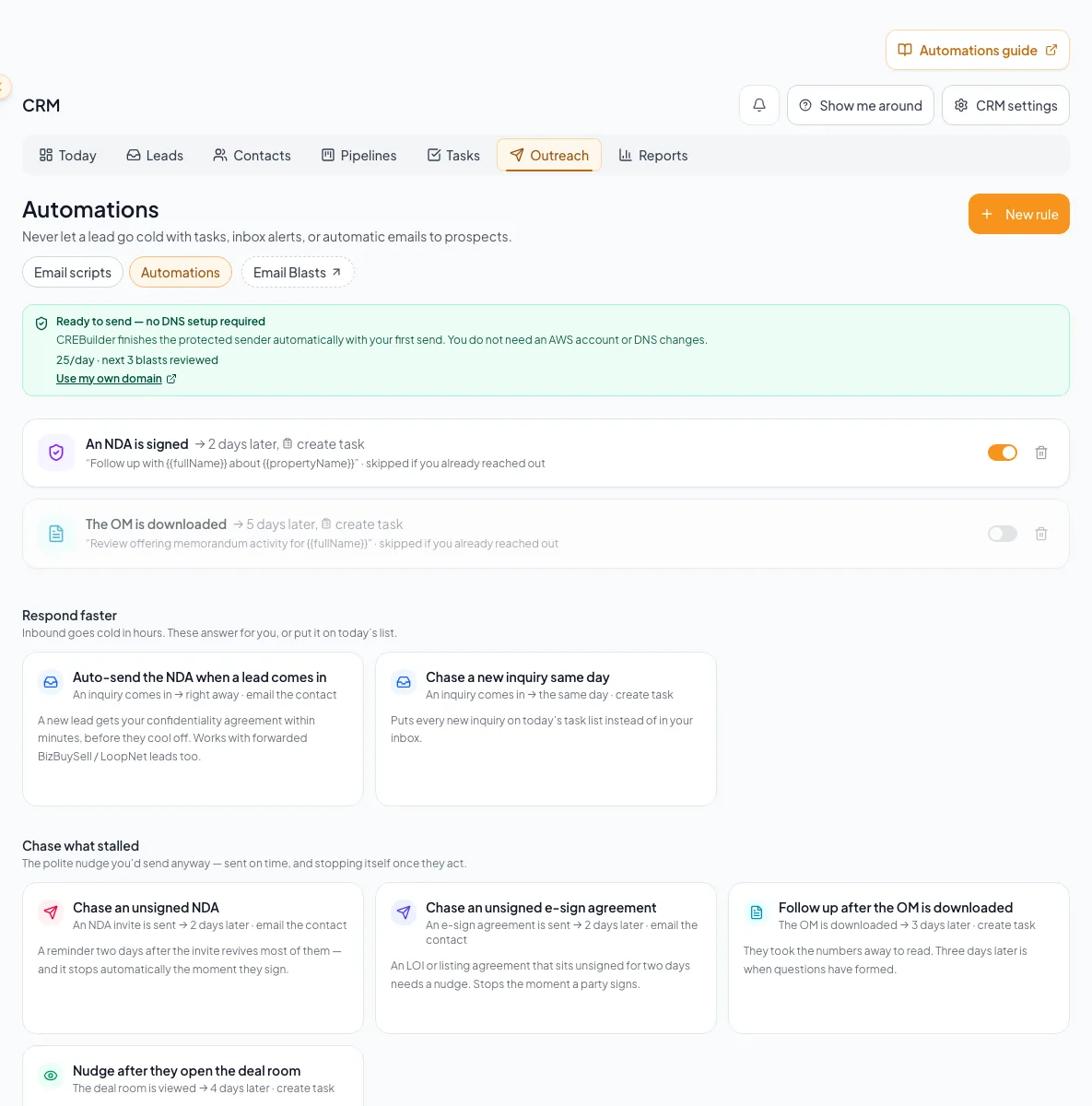
CRM > Outreach > Automations
Access
Active CREBuilder subscription with CRM entitlement
On this page
Before you start
Data, sources, and access to prepare
- CRM entitlement
- A clear business event and desired owner action
- Approved CREBuilder Mail and current agreement for contact-email actions
Choose from the current trigger and action set
| Trigger group | Events |
|---|---|
| Leads | Inquiry received; NDA invitation sent |
| Deal Room | NDA signed; room viewed; OM viewed; OM downloaded; file downloaded; access requested |
| E-signature | Agreement sent; signed; completed; declined |
| Meetings | Tour; meeting |
| Action | Destination | Prerequisite |
|---|---|---|
| Create task | Your CRM task list | Owned active contact |
| Send alert | Your own inbox | Owned active contact |
| Email contact | Hosted CREBuilder Mail to the contact | Approved Mail access, current agreement, compliance address, quota, no suppression, and review acceptance |
Rules are personal
Each user sees and manages only their own rules. A rule processes that user’s owned, non-archived contacts. Creating a team-shared script does not create a team-wide automation.
Build a rule in three steps
- 1
Choose an action or recipe
CRM > Outreach > Automations
Select a recipe in Respond faster, Chase stalled, Stay in loop, or After meeting/signature, or start a custom task, alert, or contact-email rule.
Expected result: The wizard opens with an action and any recipe defaults visible.
If this does not happen: If the business owner is unclear, cancel and define the desired response before creating a rule.
- 2
Choose the trigger
Automation wizard > Trigger
Select one supported event.
Expected result: The rule displays the event that can qualify future activity.
If this does not happen: Choose the factual source event for the intended response.
- 3
Set the delay
Automation wizard > Delay
Enter 0 to 90 days or 0 to 2160 hours.
Expected result: The rule displays a valid delay.
If this does not happen: Zero hours means the next polling pass, not immediate synchronous delivery. Allow the service polling interval.
- 4
Enter the automation content
Automation wizard > Content
Enter the task title, alert text, or email subject and body for the selected action.
Expected result: The review shows the exact output content.
If this does not happen: For email, complete Mail setup first.
- 5
Set the outreach guard
Automation wizard > Skip if already reached out
Choose whether later outreach should suppress the action.
Expected result: The review shows the outreach guard behavior.
If this does not happen: Do not weaken the guard merely to make a test fire.
- 6
Set the signature guard
Automation wizard > Stop once they sign
Choose whether an applicable signature should suppress the action.
Expected result: The final review shows the signature guard behavior.
If this does not happen: Use the guard when the action no longer makes sense after signing.
- 7
Save the rule
Automation wizard > Save
Select Save.
Expected result: The rule appears in the library.
If this does not happen: If the save fails, correct the highlighted field and retry once.
- 8
Confirm the rule is active
CRM > Outreach > Automations > rule card
Read the rule state.
Expected result: The card shows Active before the controlled test.
If this does not happen: If it is paused, verify prerequisites before selecting Resume.
- 9
Create a safe qualifying event
Controlled CRM contact activity
Create a fictional or otherwise safe qualifying event owned by you.
Expected result: The event becomes eligible for the active rule.
If this does not happen: Do not use a live contact merely to test the rule.
- 10
Verify the test output
Tasks, inbox, contact timeline, or hosted Mail status
Inspect the normal destination after the delay and polling pass.
Expected result: The task, alert, or terminal accepted email outcome appears once.
If this does not happen: If nothing appears, verify event time, ownership, active contact state, rule creation time, guards, Mail readiness, and delay before recreating the rule.
Understand timing, lookback, and guard behavior
From activity to one guarded action
The service polls for eligible facts and executes a rule at most once for each rule and source activity.
Owned contact activity
Trigger time and rule eligibility
Delay plus polling pass
Outreach, signature, suppression, quota, Mail gates
Task, alert, or accepted hosted email
- Owned contact activityTrigger time and rule eligibility
- Trigger time and rule eligibilityDelay plus polling pass
- Delay plus polling passOutreach, signature, suppression, quota, Mail gates
- Outreach, signature, suppression, quota, Mail gatesTask, alert, or accepted hosted emailpass once
| Rule behavior | Exact meaning |
|---|---|
| Task lookback | Task rules can consider qualifying activity from the previous 14 days. |
| Email and alert start boundary | They do not apply to activity that occurred before the rule was created. |
| Skip if already reached out | Skips when later note, call, meeting, tour, email-sent, or task-completed activity shows follow-up. |
| Stop once they sign | Stops on the applicable NDA-signed or agreement-signed fact. |
| Deduplication | One action per rule and qualifying source activity. |
| Hosted email completion | Only a terminal accepted send records auto_email_sent. Held or unconfirmed is not recorded as sent. |
Pause, resume, replace, and troubleshoot rules
- 1
Review the rule card
CRM > Outreach > Automations
Read action, trigger, delay, guards, and active or paused state.
Expected result: You can explain what future activity the rule can affect.
If this does not happen: There is no current per-run execution log on this page. Verify outputs in Tasks, inbox, contact timeline, or hosted Mail status.
- 2
Pause before changing intent
Automation rule card
Select Pause when the rule should stop considering new eligible work.
Expected result: The card shows paused and no longer acts as an active rule.
If this does not happen: Pausing does not erase actions already created or a hosted send already held for review.
- 3
Document the replacement rule
Automation rule card and your review notes
Copy the rule action, trigger, delay, content, and guards into your review notes.
Expected result: The notes contain a complete replacement specification before deletion.
If this does not happen: The current UI has no edit flow. Do not delete until every value on the rule card is represented in the notes.
- 4
Delete the obsolete rule
Automation rule card > Delete
Delete the exact rule being replaced.
Expected result: The obsolete rule no longer considers new activity.
If this does not happen: Confirm the rule identity before deletion.
- 5
Create the replacement rule
CRM > Outreach > Automations > New automation
Create a new rule from the recorded replacement specification.
Expected result: The new rule appears with the intended configuration.
If this does not happen: Compare the new card with the replacement notes before testing.
- 6
Test the replacement rule
Controlled CRM contact activity
Run one fictional or otherwise safe qualifying event.
Expected result: The new rule produces its intended output once.
If this does not happen: Keep the rule paused and investigate if the result differs from the specification.
- 7
Verify resume prerequisites
Paused rule card and relevant settings
Check ownership behavior for tasks or alerts, or Mail approval, current terms, compliance address, quota, and suppression policy for contact email.
Expected result: Every prerequisite for future processing is ready.
If this does not happen: If terms changed or access was revoked, keep the rule paused until Settings shows ready.
- 8
Resume the rule
Paused rule card > Resume
Select Resume.
Expected result: The rule becomes active and future eligible events can be processed.
If this does not happen: If the state does not change, reload and verify the persisted status before retrying.
An expected action did not appear
Likely cause: The event may be pre-rule, outside task lookback, not owned, archived, already processed, delayed, or blocked by a guard.
- Compare event and rule creation times.
- Confirm contact owner and active state.
- Check delay plus the polling interval.
- Inspect later outreach or signature activity.
- For Mail, check access, agreement, address, quota, suppression, and held status.
You cannot find automation errors
Likely cause: The current UI has no execution log or error monitor.
- Verify task output, your inbox, contact timeline, and Email Blast or Mail status as applicable.
- Record the rule and source activity IDs for support.
- Do not repeatedly recreate a rule while a hosted outcome is pending.
A contact-email rule is held for review
Likely cause: Hosted Mail review policy applies to automated contact email too.
- Wait for the terminal outcome.
- Do not treat held as sent.
- Only a terminal accepted send adds auto_email_sent to the timeline.
Final verification
- CRM > Outreach > Automations > New automation: The new rule appears with the intended configuration.
- Controlled CRM contact activity: The new rule produces its intended output once.
- Paused rule card and relevant settings: Every prerequisite for future processing is ready.
- Paused rule card > Resume: The rule becomes active and future eligible events can be processed.
- No blocking warning, failed status, or unresolved validation message remains in the completed workflow.