Outcome
You can create one useful company record, connect people and deals, understand domain learning, and remove a firm without erasing history.
Navigation path
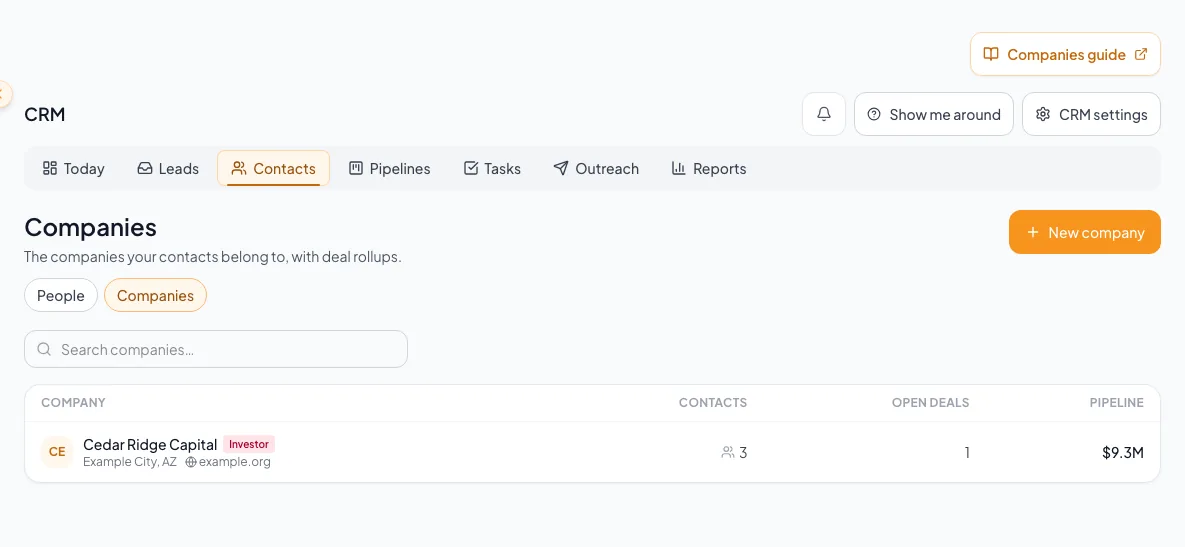
CRM > Contacts > Companies
Access
Active CREBuilder subscription with CRM entitlement
On this page
Before you start
Data, sources, and access to prepare
- CRM access
- The company name and its relationship to your team
Use companies as relationship rollups
| Field | Requirement | What it means | Format | Units | Save behavior | Downstream effect |
|---|---|---|---|---|---|---|
| Name | Required | Canonical firm name shown in CRM | Plain text | Not applicable | Stored when the company create or edit Save action succeeds. | Labels the company in contact relationships, filters, and rollups. |
| Type | Recommended | Principal, Brokerage, Lender, Tenant, Investor, or Other | One supported company-type option | Not applicable | Stored when the company create or edit Save action succeeds. | Clarifies the firm role without changing record access. |
| Owner | Recommended | Teammate responsible for the company relationship | Selected eligible teammate | Not applicable | Stored when the company create or edit Save action succeeds. | Identifies relationship responsibility; role and ownership policy still control management actions. |
| Corporate domain | Calculated | Learned nonconsumer email domain associated with the firm | Not applicable | Not applicable | No direct entry. The value updates automatically from saved linked contacts with a qualifying nonconsumer email domain. | Can file future new corporate captures into the company without granting outreach consent. |
| People and deal rollups | Calculated | Linked contact count, open-deal count, and value | Not applicable | Not applicable | No direct entry. Rollups recalculate automatically from saved company links and permitted open Deal records and values. | Summarizes the visible company relationship and transaction context. |
Required means the field is needed to complete or support this workflow. Some screens allow a draft to save before every required item is complete. The steps and troubleshooting call out controls the product actively blocks.
A company is not a mailing list
Linking people to a company helps organization and future corporate-domain filing. It does not establish marketing consent for those people.
Create a company and connect people
- 1
Search first
CRM > Contacts > Companies
Search the legal or commonly used company name.
Expected result: You know whether the firm already has a canonical company record.
If this does not happen: Try a shortened name before creating another company. If uncertain, inspect contact affiliations.
- 2
Enter the company name
Companies > Add company > Name
Enter the canonical company name.
Expected result: The form has the required company identity.
If this does not happen: Preserve the entered name if a later save attempt fails.
- 3
Choose the company type
Companies > Add company > Type
Select the firm’s supported relationship type.
Expected result: The form reflects the company’s role.
If this does not happen: Use Other only when the supported types do not fit.
- 4
Assign the company owner
Companies > Add company > Owner
Select the responsible teammate when the control is offered.
Expected result: The form identifies the relationship owner.
If this does not happen: Leave the default only when it matches team policy.
- 5
Save the company
Companies > Add company > Save
Select Save.
Expected result: The company detail workspace opens with empty or initial rollups.
If this does not happen: If save fails, retry once without creating another near-identical firm.
- 6
Choose a company contact
Company detail > People
Select an existing person or start a permitted new contact.
Expected result: The company-association form shows the intended person.
If this does not happen: If the person belongs to a different firm, verify the change before proceeding.
- 7
Confirm the company association
Company detail > People > association confirmation
Select Confirm.
Expected result: The person appears under the company and their contact workspace shows the firm.
If this does not happen: Preserve important prior affiliation context in a note if useful.
- 8
Verify deal relationships
Company detail > Deals
Review deals where the firm is primary or appears as an additional party.
Expected result: Open deal counts and values reflect the linked opportunities.
If this does not happen: If a deal is missing, update the deal party relationship rather than creating a duplicate deal.
Understand corporate-domain learning
How a corporate domain helps future filing
Linking an appropriate corporate address can teach CRM where future new captures from that domain belong.
Contact linked to company
Eligible corporate domain learned
Future new captured contact
Auto-filed to company
- Contact linked to companyEligible corporate domain learnedlearn
- Eligible corporate domain learnedFuture new captured contactcompare
- Future new captured contactAuto-filed to companymatch
Boundaries
- Consumer domains should not identify a company.
- Domain learning helps classify future new captures, not rewrite every existing contact.
- A matching domain is organizational evidence, not proof of identity or consent.
- Review auto-filed contacts when two firms share infrastructure or a holding-company domain.
Remove a company only after checking consequences
- 1
Review relationships
Company detail
Inspect people, open deals, additional deal parties, activity, owner, and rollups.
Expected result: You understand what will remain after company removal.
If this does not happen: Reassign active responsibility before deleting the company record.
- 2
Review the company-removal warning
Company detail > Delete or remove company
Read the irreversible confirmation for the exact firm.
Expected result: You understand which current relationships and historical records will remain.
If this does not happen: Cancel the dialog if the named firm or consequences are not correct.
- 3
Confirm company removal
Company-removal confirmation
Select the final confirmation action.
Expected result: The firm is archived/removed, contacts detach, and historical company names and deal history remain.
If this does not happen: There is no normal UI restore. If removed in error, stop and contact support with the company identity.
You can see but cannot manage the company
Likely cause: Company management is limited by ownership and role.
- Check the displayed owner.
- Ask an authorized company-wide user to make or transfer the change.
- Do not duplicate the firm.
Rollups do not include an expected deal
Likely cause: The deal is not linked to the company as its contact firm or an additional party.
- Open the deal.
- Review contact and party relationships.
- Add the correct party rather than altering value totals manually.
A future capture filed to the wrong company
Likely cause: The learned corporate domain is shared or ambiguous.
- Move the contact to the correct company.
- Document the shared-domain issue.
- Review subsequent captures from that domain.
Final verification
- Company detail > Deals: Open deal counts and values reflect the linked opportunities.
- Company detail: You understand what will remain after company removal.
- Company detail > Delete or remove company: You understand which current relationships and historical records will remain.
- Company-removal confirmation: The firm is archived/removed, contacts detach, and historical company names and deal history remain.
- No blocking warning, failed status, or unresolved validation message remains in the completed workflow.