Outcome
You can keep Assignment and Listing lifecycles distinct, use their boards honestly, and administer stages without stranding records.
Navigation path
CRM > Pipelines > Representation opportunities or Listing progress
Access
Active CREBuilder subscription with CRM entitlement
On this page
Before you start
Data, sources, and access to prepare
- A real assignment pursuit or represented listing
- Pipeline administration authority for stage changes
Keep the two lifecycles distinct
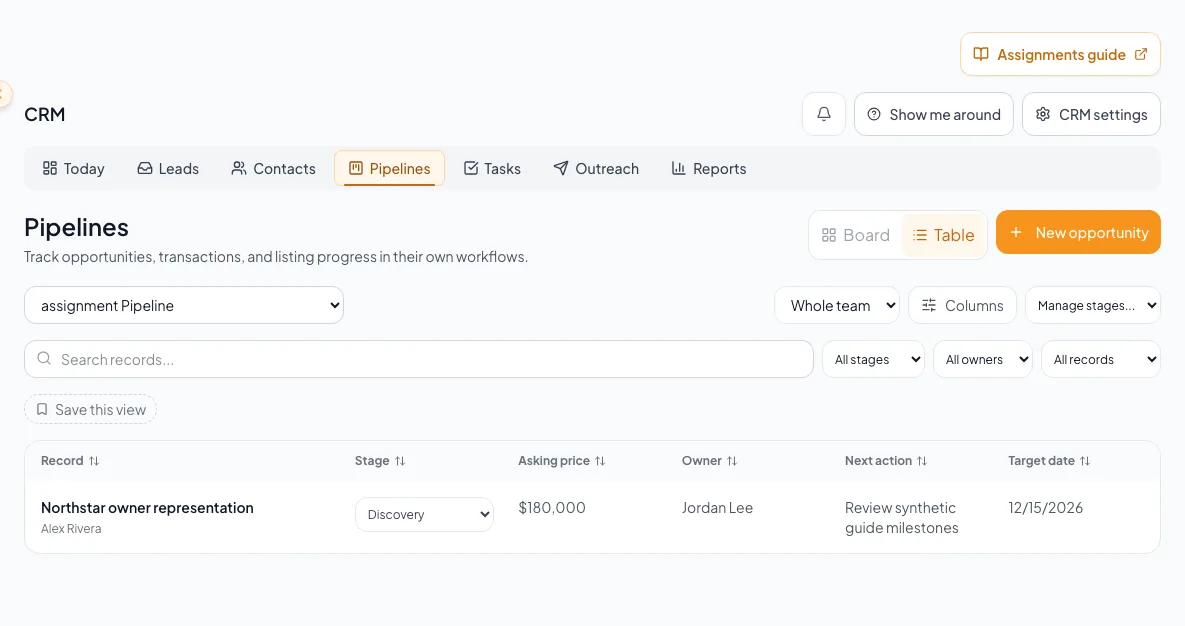
Short animated UI capture. No audio.
| Pipeline | Starts when | Tracks until | Related Deal |
|---|---|---|---|
| Assignment | You pursue an owner engagement, tenant search, or other mandate | The pursuit is won, lost, or no longer active | Create or maintain a Deal when a specific expected transaction should be forecast. |
| Listing | Your team represents a property and prepares or markets it | The listing reaches its terminal outcome | A Deal can represent the expected transaction and economics separately. |
Related does not mean interchangeable
An Assignment, Listing, and Deal can all relate to one business opportunity but answer different questions. Keep each stage and value specific to its own lifecycle.
Create and work a board record
- 1
Open the right pipeline
CRM > Pipelines > grouped pipeline selector
Choose the lifecycle before creating the record.
Expected result: The appropriate board or list loads.
If this does not happen: If the record already exists in another view, open it instead of creating a duplicate.
- 2
Choose the pipeline definition
Pipelines > grouped pipeline selector
Select the pipeline that matches the work.
Expected result: The selected custom stages apply to newly created records.
If this does not happen: If the required definition is unavailable, ask a pipeline administrator rather than using a misleading substitute.
- 3
Enter the operating fields
New opportunity or New listing
Enter the required contact and property name for an opportunity, or a listing name for listing progress.
Expected result: The form contains the known operating details.
If this does not happen: Leave an optional value blank instead of inventing it.
- 4
Save the board record
Opportunity or listing form > create action
Select Create opportunity for an opportunity, or Create for listing progress.
Expected result: The record appears in the selected starting stage.
If this does not happen: If the save fails, correct the highlighted field and retry once.
- 5
Use Board or Table
Pipelines > view toggle
Choose Board for stage movement or Table for sortable scanning.
Expected result: The same permitted records appear in the chosen view.
If this does not happen: If a filter or scope changed, restore it before comparing counts.
- 6
Open the record workspace
Pipeline record name
Select the opportunity or listing name.
Expected result: The dedicated workspace opens with its stage, details, Updates, and Files.
If this does not happen: If a required value is unknown, leave it blank rather than entering a placeholder.
- 7
Edit the operating details
Record workspace > Edit opportunity or Edit listing details
Select the record edit action.
Expected result: The form contains the current property details and supports explicit Save and Cancel.
If this does not happen: If the change fails, reload and verify persistence before re-entering it.
Move, close, reopen, and administer stages
- 1
Move after the milestone
Assignment or Listing board
Drag the card or use the touch stage control only after the real lifecycle event.
Expected result: The card enters the factual stage and age indicators update.
If this does not happen: If the server rejects the move, reload and inspect the current persisted stage.
- 2
Review the terminal guard
Stage movement to Won or Lost
Read the terminal-state guard.
Expected result: The confirmation explains the terminal stage being selected.
If this does not happen: Cancel if the lifecycle is not truly complete.
- 3
Confirm the terminal outcome
Stage movement to Won or Lost > Confirm
Select Confirm.
Expected result: The record becomes terminal; returning it to active work requires Reopen confirmation.
If this does not happen: If confirmed in error, open the card and use Reopen. Do not create a replacement record.
- 4
Start reopening the record
Terminal record > Reopen
Select an active stage using the record stage control.
Expected result: The Reopen confirmation explains that this resumes work on the existing record.
If this does not happen: If Reopen is unavailable, confirm ownership and role before contacting support.
- 5
Choose the reopened stage
Terminal record > Reopen confirmation
Select Reopen to confirm the chosen active stage.
Expected result: The existing record returns to active work with its history intact.
If this does not happen: Choose the stage that matches the current factual milestone.
- 6
Select the stage to remove
Pipeline stage administration
Select the unused stage.
Expected result: The removal workflow identifies any records that must move.
If this does not happen: Protected, terminal, or capture-critical stages may not be removable. Keep them and choose a different administration action.
- 7
Choose the record destination
Pipeline stage administration > destination
Select a valid destination stage for the affected records.
Expected result: The workflow shows where the records will move.
If this does not happen: Do not choose a destination with a different lifecycle meaning merely to continue.
- 8
Review the affected count
Pipeline stage administration > review
Review the number of records that will move.
Expected result: The scope of the stage removal is clear before confirmation.
If this does not happen: Cancel if the count is unexpected and inspect the source stage.
- 9
Confirm stage removal
Pipeline stage administration > Confirm
Select Confirm.
Expected result: Records move to the destination and the unused stage is removed.
If this does not happen: If confirmation fails, reload the administration page and verify that no partial change occurred.
Terminal states require an explicit return path
Board movement closes active work, but reopening is a separate guarded action.
Active stage
Won or Lost confirmation
Terminal record
Explicit Reopen
- Active stageWon or Lost confirmationmove
- Won or Lost confirmationTerminal recordconfirm
- Terminal recordExplicit Reopenresume
- Explicit ReopenActive stagereturn
Work within current limitations
Dedicated property workspaces
Select an opportunity or listing name to open its workspace. Opportunities keep property details, tasks, Updates, and Files together. Create or link listing connects the same property history without publishing it.
You cannot administer stages
Likely cause: Stage administration is role restricted. A lone active Regular User has a narrow exception, while a Coordinator does not.
- Confirm the current role and company users.
- Ask a company-wide pipeline administrator.
- Do not repurpose protected stages.
A stage delete asks where to move records
Likely cause: The stage is in use and cannot disappear while records still reference it.
- Choose a factual destination.
- Review the moved-record count.
- Cancel if one destination would misstate different records, then move them individually first.
You need more context than the card shows
Likely cause: The pipeline shows a compact summary of the record.
- Select its name to open the dedicated workspace.
- Review property details, Updates, Files, and the next action there.
- For an opportunity, use Tasks to assign a property-specific follow-up.
Final verification
- Pipeline stage administration: The removal workflow identifies any records that must move.
- Pipeline stage administration > destination: The workflow shows where the records will move.
- Pipeline stage administration > review: The scope of the stage removal is clear before confirmation.
- Pipeline stage administration > Confirm: Records move to the destination and the unused stage is removed.
- No blocking warning, failed status, or unresolved validation message remains in the completed workflow.