Outcome
You can keep a Deal internally consistent from first qualification through offers, parties, commission allocation, agreement visibility, close, and archival review.
Navigation path
CRM > Pipelines > Deals
Access
Active CREBuilder subscription with CRM entitlement
On this page
Before you start
Data, sources, and access to prepare
- At least one permitted Deal or a qualified opportunity ready to create
- Confirmed transaction facts or clearly labeled estimates
- The correct contact and property or suite
Set pipeline, scope, and view
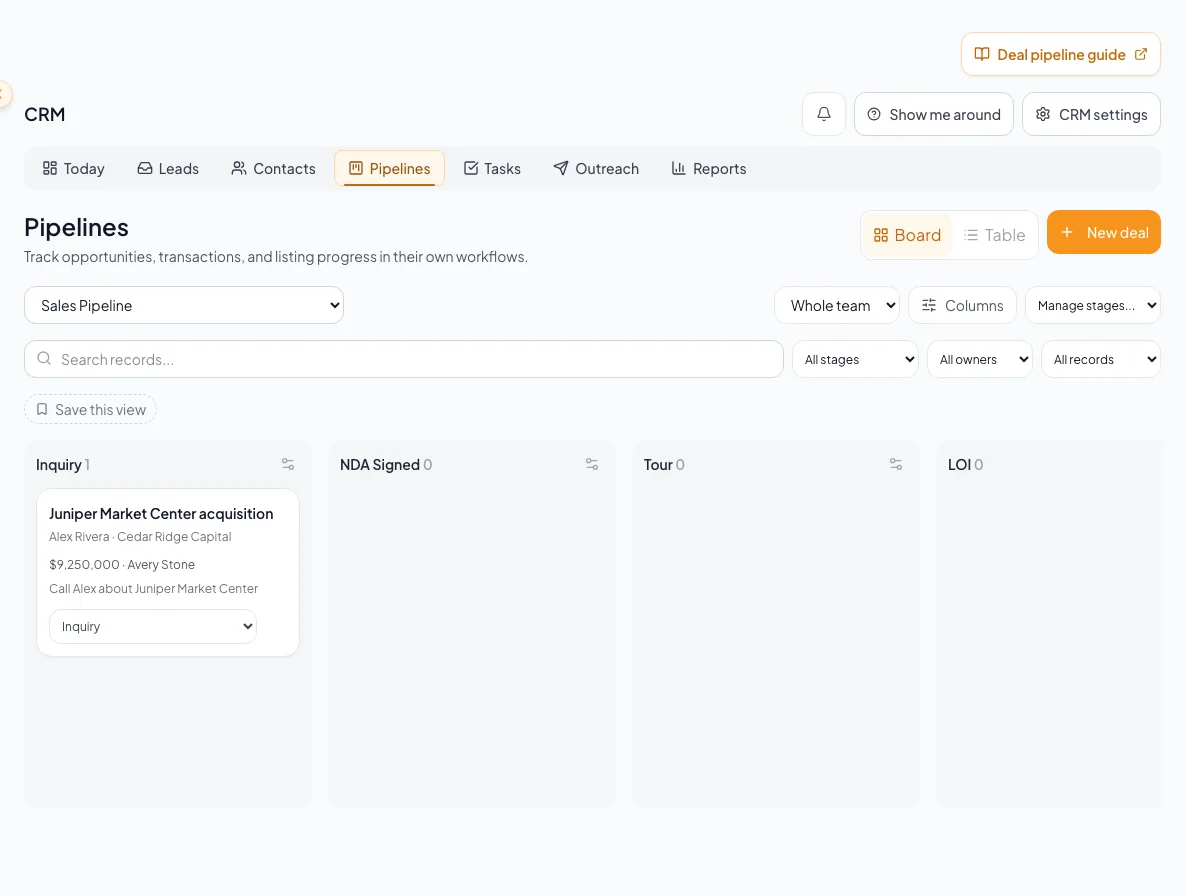
Short animated UI capture. No audio.
- 1
Choose the Deal pipeline
CRM > Pipelines > Deals > pipeline selector
Select Property or Business Sales when both exist.
Expected result: Only deals assigned to that pipeline appear. Switching does not move any record.
If this does not happen: If a deal is absent, check the other pipeline before creating a new one.
- 2
Choose scope
Deals > scope control
Select Mine or Whole team when your role allows it.
Expected result: The page reloads within your authorization ceiling.
If this does not happen: If Whole team is not offered, use own scope or ask an authorized reviewer.
- 3
Choose Board or List
Deals > view toggle
Select Board for stage management or List for sortable deal details.
Expected result: The same filtered deals render in the selected view and the preference persists.
If this does not happen: If counts differ, confirm that the pipeline, scope, and Today deep-link filters stayed the same.
Read cards, columns, and list data
| Surface | Signals |
|---|---|
| Stage column | Deal count, gross value, weighted value, and stage probability |
| Board card | Title, contact/company context, value, close date, stage age, rotting/stale state, notes, and open-task signal as available |
| List row | Deal/contact, stage, value, days, last activity, and created date with sortable columns |
| Today-filtered list | Stale or missing-next-action context carried from Today |
Advance a deal and preserve context
- 1
Open the deal before a major move
Deals board card or list row
Review contact, property or suite, value, close date, open tasks, and recent activity.
Expected result: The proposed stage reflects the actual transaction.
If this does not happen: If the contact and suite duplicate another deal, stop and use the existing record.
- 2
Move to the factual stage
Deals > Board
Drag the card on pointer devices or use the stage dropdown on touch devices.
Expected result: The deal moves, stage totals update, and stage age restarts.
If this does not happen: If the request fails, the card should return. Reload and verify the persisted stage before trying again.
- 3
Add the next action
Deal context and related task workflow
Create or update the follow-up that must happen next, with owner and due time where the UI permits.
Expected result: The deal no longer lacks a next action and appears correctly in Today.
If this does not happen: If task linking is not offered in the visible deal screen, create the task from the supported contact or Tasks workflow and use a precise title.
- 4
Set the terminal outcome
Deal detail or stage control
Select Won or Lost only on a true outcome.
Expected result: ClosedAt and reporting behavior align with the real close outcome.
If this does not happen: Do not use a terminal stage for paused or uncertain work.
- 5
Reopen a resumed Deal
Terminal Deal > Reopen
Select Reopen if the transaction resumes.
Expected result: The existing Deal returns to active work with history intact.
If this does not happen: Do not drag a terminal card to simulate reopening.
Verify identity and core economics
| Field | Requirement | What it means | Format | Units | Save behavior | Downstream effect |
|---|---|---|---|---|---|---|
| Title and contact | Required | Opportunity name and canonical person | Plain-text Deal title plus one existing CRM contact | Not applicable | The title saves only after Save name or Enter succeeds. The primary contact is fixed when the Deal is created and is not editable on this detail screen. | The title labels the Deal, and the contact links the transaction to that person’s CRM context. |
| Property and suite | Optional | Transaction location and optional space | Linked property plus Whole building or one listed suite | Not applicable | The property link is established by the creation or listing-engagement workflow. Selecting a suite submits immediately and persists only if the update succeeds. | Links the Deal to its property or space and prevents another Deal for the same contact and suite. |
| Value | Recommended | Expected transaction value used by pipeline and forecast calculations | Numeric currency amount | U.S. dollars | The Deal economics input submits when it loses focus and persists only if the update succeeds. | Feeds stage and pipeline gross value, weighted value, and percentage-based gross commission calculations. |
| Close date | Recommended | Expected or actual closing month used in forecast grouping | Date in YYYY-MM-DD format | Calendar date | The Expected close date submits when its input loses focus and persists only if the update succeeds. | Groups the Deal into the applicable expected or actual closing month for forecast and reporting context. |
| Side | Recommended | The represented transaction side | Buy-side, Sell-side, Landlord, Tenant, or blank | Not applicable | Selecting a Side submits the choice immediately and persists only if the update succeeds. | Records whom the team represents without changing the Deal owner, pipeline, or stage. |
| Commission value | Optional | Explicit flat GCI | Numeric currency amount | U.S. dollars | No customer edit control is present for this value on the current Deal detail screen, so this screen does not save it. | When a stored flat value is present, it takes precedence over the percentage calculation for gross GCI, splits, and reports. |
| Commission percent | Optional | GCI percent applied to Deal value when no flat commission is entered | Decimal percentage; the input steps by 0.1 | Percent | A numeric percentage submits when the Commission input loses focus and persists only if the update succeeds. | Calculates gross GCI from Deal value only when no flat commission value is stored; splits and reports use the resulting GCI. |
Required means the field is needed to complete or support this workflow. Some screens allow a draft to save before every required item is complete. The steps and troubleshooting call out controls the product actively blocks.
- 1
Confirm Deal identity
Deal detail > header
Verify title, contact, Deal pipeline, property, and suite before editing.
Expected result: You are updating the intended transaction and not a duplicate contact and suite Deal.
If this does not happen: If another matching Deal exists, stop and compare stage and history. Do not bypass duplicate protection.
- 2
Update forecast fields
Deal detail > Economics
Enter current value, close date, represented side, and commission percentage where offered.
Expected result: Board, forecast, weighted pipeline, and GCI use current values.
If this does not happen: If the commission result is surprising, check for an explicit flat value before changing the percentage.
- 3
Document assumptions
Deal workspace > Updates
Add a concise note for any material estimate, change, or unresolved fact.
Expected result: The timeline explains why the current economics and stage were chosen.
If this does not happen: Do not present an undocumented estimate as a final transaction fact.
Record offer rounds, commission splits, and parties
| Area | Supported detail | Important boundary |
|---|---|---|
| Offers or LOIs | Buyer or seller direction, price, deposit, due-diligence days, financing tri-state, close date, and status | Add a round instead of overwriting negotiation history. |
| Commission splits | Agent, house, co-broke, or referral; internal user or external party | The current customer UI primarily captures percentages even though the service can represent fixed values. |
| Additional parties | Buyer, Buyer broker, Seller, Seller broker, Attorney, Lender, or Other | A party relationship does not transfer CRM ownership. |
- 1
Add an offer round
Deal detail > Offers
Create a new round with direction, economics, contingencies, target close, and current status.
Expected result: The new round appears without erasing earlier negotiation.
If this does not happen: Leave unknown values unset or use the supported unknown financing state. Do not copy a prior round without review.
- 2
Add commission splits
Deal detail > Splits
Add agent, house, co-broke, and referral rows with the correct internal user or external name and percentage.
Expected result: The split summary shows the entered allocation and any total warning.
If this does not happen: If no split rows exist, reporting assigns full GCI to the Deal owner. Add rows only when the allocation is known.
- 3
Review the split total
Deal detail > Splits summary
Compare the intended allocations with the displayed total.
Expected result: A complete allocation totals 100 percent, while a partial allocation remains visible with a warning.
If this does not happen: Do not add a fake balancing user.
- 4
Correct a split row
Deal detail > Splits
Correct one omission or overlapping allocation.
Expected result: The split summary recalculates from the corrected row.
If this does not happen: Confirm the intended house or external allocation before editing.
- 5
Choose an additional-party role
Deal detail > Parties
Select the participant’s role.
Expected result: The party editor is ready for the related identity.
If this does not happen: Use Other only when the listed roles do not fit.
- 6
Link the additional party
Deal detail > Parties
Link a known CRM contact or company, or enter supported external context.
Expected result: Every material participant is visible separately from the primary contact.
If this does not happen: If a party changes, update the relationship and preserve important history in a note.
Read notes and agreement activity, then archive with care
Deal Activity is the shared audit trail for notes and supported lifecycle events. Agreement sent, signed, executed, declined, or voided events can appear there when another authorized workflow links an agreement to the Deal.
Agreement management is outside the public Deal workflow
Customer roles can use the visible Deal record and activity history documented here. Agreement creation and administration controls are not a customer-facing CRM action, so this guide does not instruct users to open internal administration pages.
- 1
Add a useful note
Deal workspace > Updates > Write an update
Record the decision, material change, responsible person, and next action without sensitive material that does not belong in CRM.
Expected result: The note appears chronologically with author and timestamp.
If this does not happen: If the save fails, preserve the text locally, retry once, and confirm it appears before closing.
- 2
Interpret agreement events
Deal workspace > Updates
Read the event label and timestamp as lifecycle context.
Expected result: The Deal history reflects known agreement progress without exposing unsupported controls.
If this does not happen: If action is required, use the approved agreement workflow outside this public guide. Escalate a conflict with the Deal and agreement identifiers.
- 3
Audit before archiving
Deal detail
Review the complete record, including stage, economics, offers, splits, parties, notes, and outstanding follow-up.
Expected result: The exact obsolete or duplicate Deal is identified for archive.
If this does not happen: Cancel archival if any active obligation remains.
- 4
Archive the Deal
Deal detail > Archive
Select Archive.
Expected result: The Deal leaves active work while transaction history remains retained.
If this does not happen: There is no normal visible restore workflow. Contact support immediately if the wrong Deal is archived.
A duplicate contact and suite combination is rejected
Likely cause: An existing Deal already represents that person and space.
- Search both Deal pipelines.
- Open the existing Deal.
- Update its stage, offer, or economics instead of creating another.
By Agent GCI is lower than Deal GCI
Likely cause: Internal agent split rows control agent rollup, while house, referral, and external rows reduce residual.
- Review every split row.
- Confirm internal users are linked correctly.
- Confirm the total and Deal owner.
- Use the no-split owner default only when that is the actual arrangement.
Agreement activity is visible but no public action is available
Likely cause: The lifecycle event is readable Deal context, while agreement administration is intentionally outside the customer CRM surface.
- Record the event and Deal identifiers.
- Use the organization’s approved agreement process.
- Ask support when lifecycle state appears inconsistent.
Understand automated Deal creation and recover safely
Listing engagement can promote a Deal forward
Qualifying property engagement can create or advance an open deal, while terminal records remain untouched.
Qualifying listing engagement
Open matching Deal?
Create and seed value when appropriate
Advance forward only
Won or Lost Deal
No automatic reopening
- Qualifying listing engagementOpen matching Deal?
- Open matching Deal?Create and seed value when appropriateno open match
- Open matching Deal?Advance forward onlyopen match
- Qualifying listing engagementWon or Lost Dealleave unchanged
A Deal appeared after listing activity
Likely cause: The capture workflow can create or promote an open matching Deal and may seed asking price.
- Open the timeline and source property.
- Confirm the contact and suite.
- Correct value, owner, close date, and next action as facts become known.
- Do not delete valid engagement merely because creation was automatic.
A Deal looks stale despite recent off-platform work
Likely cause: The CRM has no recorded activity for that work.
- Add a truthful note, call, meeting, tour, or verified email activity.
- Update the next task.
- Do not fabricate dates solely to clear the stale signal.
Board movement is hard on mobile
Likely cause: Horizontal columns and touch input differ from pointer drag.
- Use the touch stage selector on the card.
- Use horizontal board navigation.
- Switch to List when comparison is easier there.
Final verification
- Deal workspace > Updates > Write an update: The note appears chronologically with author and timestamp.
- Deal workspace > Updates: The Deal history reflects known agreement progress without exposing unsupported controls.
- Deal detail: The exact obsolete or duplicate Deal is identified for archive.
- Deal detail > Archive: The Deal leaves active work while transaction history remains retained.
- No blocking warning, failed status, or unresolved validation message remains in the completed workflow.