Outcome
The document presents storage inventory, occupancy, rents, and operating analysis with accurate unit-based metrics.
Navigation path
Create New > Self-Storage > Document wizard
Access
Document creation access
On this page
Before you start
Data, sources, and access to prepare
- Storage unit count by type
- Average rent and occupancy
- Operating statement when Full Financials is used
Use Unit Inventory
Self-Storage analysis
Storage category inventory drives unit occupancy and rent.
Unit Inventory
Size, count, average SF, rent
Unit Occupancy
Occupied units divided by total units
Storage Income
Rent plus fees, insurance, and retail
Storage Metrics
Price/Unit and Price/SF
- Unit InventoryUnit Occupancy
- Unit InventoryStorage Income
- Unit OccupancyStorage Metrics
- Storage IncomeStorage Metrics
| Area | Self-Storage behavior |
|---|---|
| Rent Roll label | Unit Inventory |
| Occupancy | By unit count |
| Price metrics | Price/Unit and Price/SF |
| Rent bases | Monthly or Annual |
| Lease dates | Hidden |
| Reimbursements | Hidden |
| Vacancies | Supported |
Enter category economics
| Field | Requirement | What it means | Format | Units | Save behavior | Downstream effect |
|---|---|---|---|---|---|---|
| Unit Type | Required | Storage size or product category. | Plain-text storage category label | Not applicable | Saved when the storage unit or Unit Mix drawer Save action succeeds. | Labels the row in Unit Inventory and the Self-Storage presentation. |
| Number of Units | Required | Count represented by a Unit Mix row. | Positive whole number | Storage units | Saved when the Unit Mix drawer Save action succeeds. | Multiplies per-unit rent and area and contributes to total-unit occupancy and Price/Unit. |
| Average SF | Recommended | Average rentable area for the category. | Nonnegative number | Square feet per storage unit | Saved when the storage unit or Unit Mix drawer Save action succeeds. | Contributes to row area, total rentable area context, and applicable Price/SF output. |
| Monthly or Annual Rent | Recommended | Per-unit current rent. | Currency amount plus Monthly or Annual basis | Currency per storage unit per month or per year | Saved when the storage unit or Unit Mix drawer Save action succeeds. | Annualizes per-unit rent, multiplies grouped rows by count, and feeds storage base rent. |
| Facility Maintenance | Optional | Storage-specific Cap Ex reserve label. | Nonnegative currency rate | Currency per unit per year | Begins the Assumptions 800 ms autosave after entry; reopen assumptions to verify persistence. | Creates the storage-labeled facility-maintenance reserve deduction using the occupied and vacant inventory quantity for the displayed reserve basis. |
| Cap Improvements | Optional | Storage-specific TI reserve label. | Nonnegative currency rate | Currency per unit per year | Begins the Assumptions 800 ms autosave after entry; reopen assumptions to verify persistence. | Creates the storage-labeled capital-improvements reserve deduction using the occupied and vacant inventory quantity for the displayed reserve basis. |
| Marketing/Leasing | Optional | Storage-specific leasing reserve label. | Nonnegative currency rate | Currency per unit per year | Begins the Assumptions 800 ms autosave after entry; reopen assumptions to verify persistence. | Creates the storage-labeled marketing or leasing reserve deduction using the occupied and vacant inventory quantity for the displayed reserve basis. |
Required means the field is needed to complete or support this workflow. Some screens allow a draft to save before every required item is complete. The steps and troubleshooting call out controls the product actively blocks.
Suggested other income
- Late fees
- Administration fees
- Insurance income
- Truck rental
- Retail sales
Complete the Self-Storage workflow
Self-Storage steps
- 1
Select Self-Storage
Create New, Select Property Type
Choose Self-Storage.
Expected result: Unit Inventory and storage labels activate.
If this does not happen: Change the property type in Property Details if needed.
- 2
Verify total units and price
Property Details
Enter accurate unit count, area, and selling price.
Expected result: Price/Unit and Price/SF have valid denominators.
If this does not happen: Correct property totals before entering grouped inventory.
- 3
Choose the inventory layout
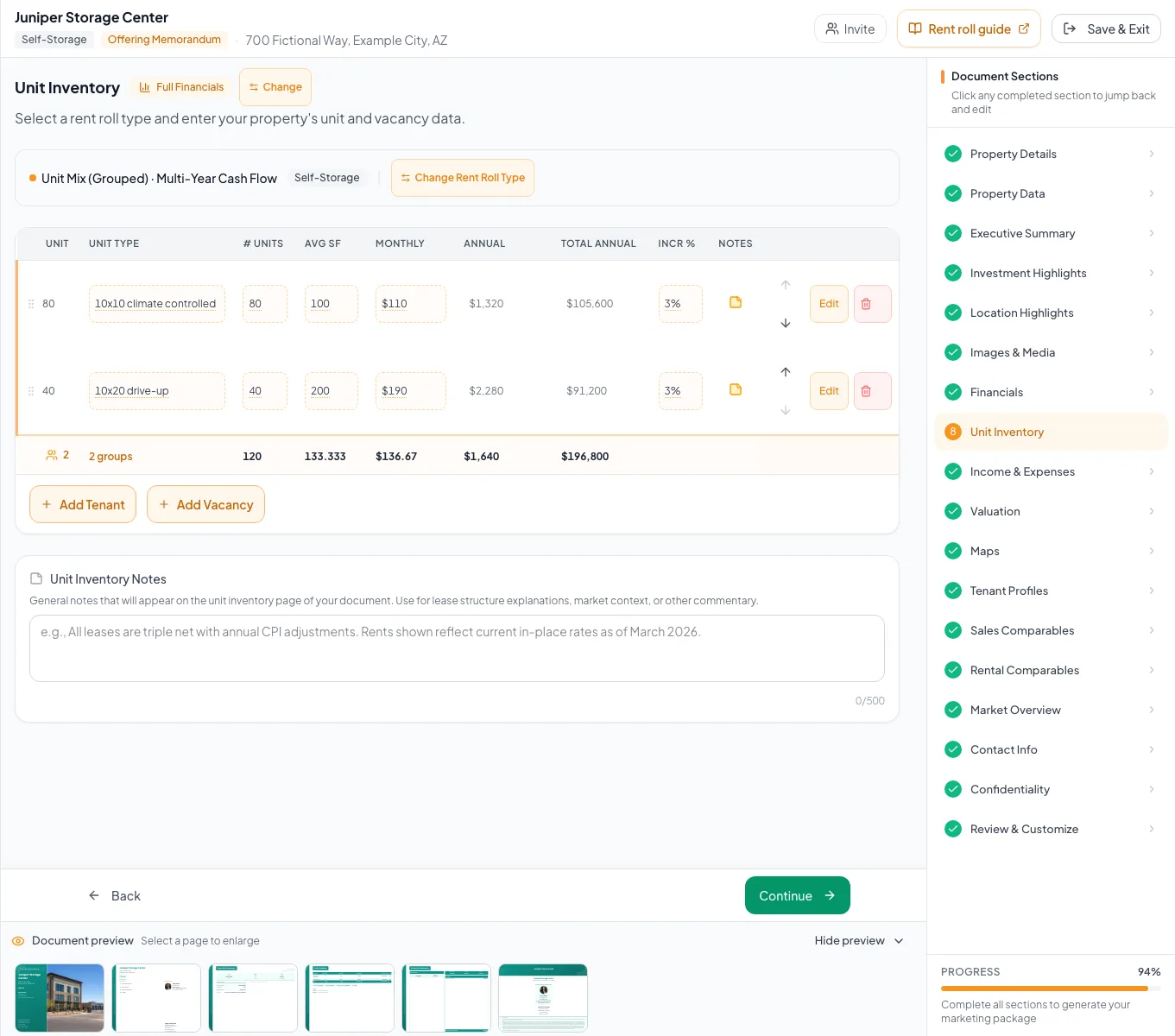
Rent Roll, Unit Inventory > layout selector
Select individual input or Unit Mix.
Expected result: The inventory table matches the source schedule structure.
If this does not happen: Use Unit Mix when the source provides repeated category averages.
- 4
Build Unit Inventory
Rent Roll, Unit Inventory
Enter occupied and vacant categories with count, SF, and per-unit rent.
Expected result: Inventory count and annual rent reconcile.
If this does not happen: Check that grouped rent is per unit, not the category total.
- 5
Enter storage income and expenses
Income & Expenses
Add verified fee, insurance, truck, retail, and operating-expense rows.
Expected result: EGI and NOI reconcile.
If this does not happen: Do not enter generic tenant reimbursements because the storage configuration hides them.
- 6
Verify output
Review & Customize
Check unit count, occupancy, Price/Unit, Price/SF, inventory labels, reserves, and financial pages.
Expected result: The final document uses Self-Storage terminology throughout.
If this does not happen: Return to the source field for the first mismatch.
Resolve Self-Storage issues
Inventory rent is overstated
Likely cause: A total category rent was entered as per-unit rent and multiplied by unit count.
- Enter per-unit rent.
- Confirm category count.
- Recheck annual total.
Lease-date fields are missing
Likely cause: Self-Storage intentionally hides commercial lease dates.
- Use Unit Inventory fields.
- Add material operating context in notes if necessary.
Reserve dollars do not match per-unit math
Likely cause: Current generation applies reserve rates using total SF.
- Independently calculate the intended reserve.
- Approve or escalate the displayed output before publishing.
- Unit count verified
- Occupied and vacant inventory reconciled
- Per-unit rent correct
- Other income sourced
- Price metrics checked
- Reserve dollars reviewed
Related guides
Build unit, storage, and pad rent rolls
Use property-specific unit inventory for Multifamily, Self-Storage, and Mobile Home Park documents.
Open guideEnter income and operating expenses
Build the non-rental income and operating expense statement used to calculate effective gross income and NOI.
Open guideVerify financial pages before publishing
Confirm scope-based page inclusion, property-specific exceptions, calculations, footnotes, and final document presentation.
Open guide