Outcome
A Retail document uses complete physical facts, tenant data, and retail-specific financial terminology.
Navigation path
Create New > Retail > Document wizard
Access
Document creation access
On this page
Before you start
Data, sources, and access to prepare
- Retail address and physical facts
- Tenant and vacancy schedule when financials are included
Use the retail data model
Retail document model
Retail combines site and merchandising facts with commercial tenant economics.
Property Facts
GLA, frontage, parking, traffic
Tenant Rent Roll
Space, rent, lease, reimbursement
Retail Income
Base rent plus applicable CAM and other income
Retail Presentation
Price/SF and tenant-focused pages
- Property FactsRetail Presentation
- Tenant Rent RollRetail Income
- Retail IncomeRetail Presentation
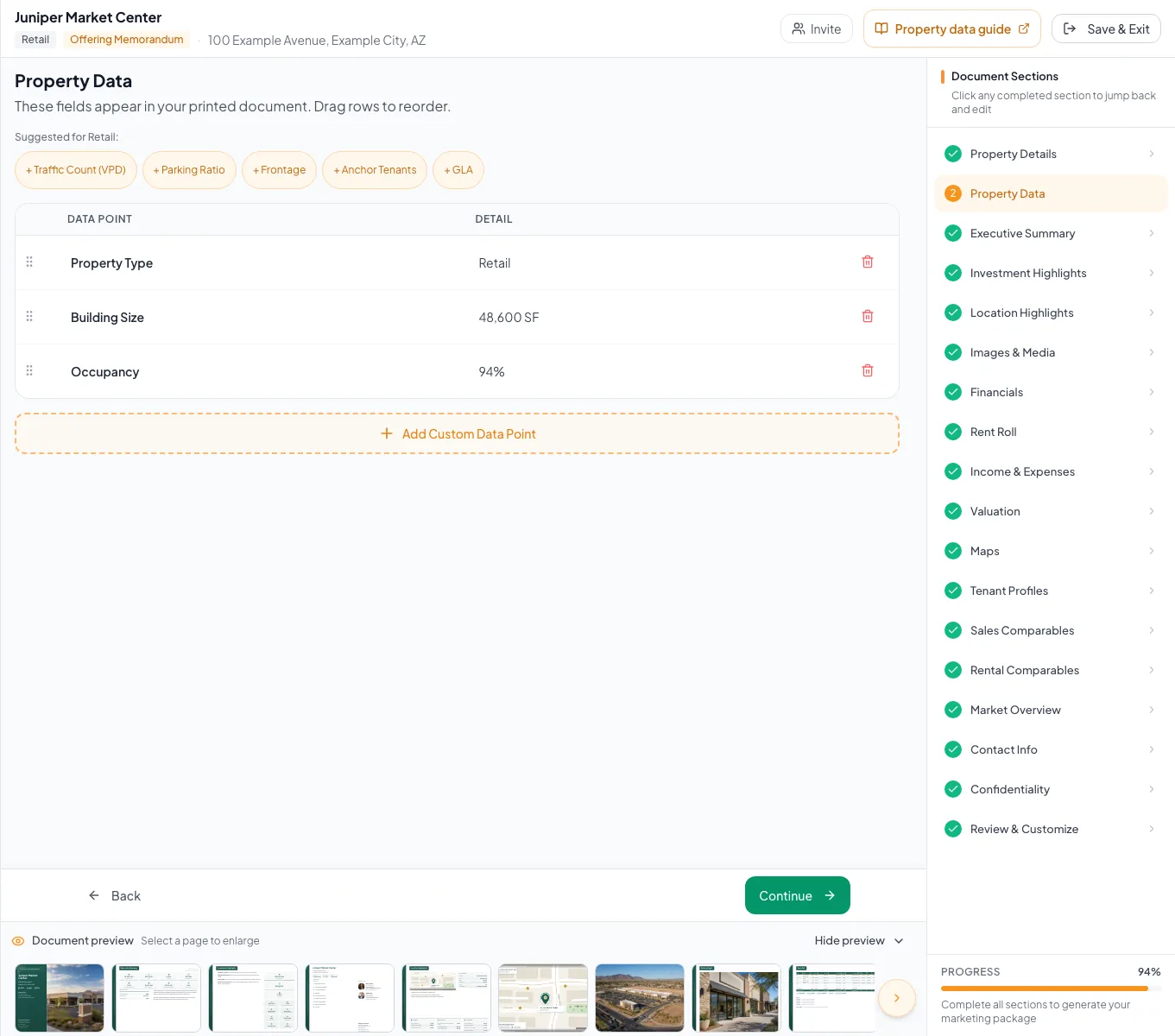
Suggested Retail property data
| Field | Requirement | What it means | Format | Units | Save behavior | Downstream effect |
|---|---|---|---|---|---|---|
| Traffic Count (VPD) | Optional | Vehicle volume supporting location context. | Whole-number Property Data value, optionally with source-year context | Vehicles per day (VPD) | Property Data autosaves two seconds after the value stops changing. | Displays verified traffic context in the property-data presentation; it does not alter rent-roll economics. |
| Parking Ratio | Optional | Parking supply relative to building area. | Decimal Property Data value with the ratio basis stated | Parking spaces per 1,000 square feet | Property Data autosaves two seconds after the value stops changing. | Displays parking capacity in Retail property facts for reader comparison. |
| Frontage | Optional | Street or access exposure. | Numeric length plus the relevant street or access description | Feet or the verified source unit | Property Data autosaves two seconds after the value stops changing. | Adds verified visibility and access context to the Retail property-data table. |
| Anchor Tenants | Optional | Major retailers driving center identity. | Plain-text tenant names | Not applicable | Property Data autosaves two seconds after the value stops changing. | Lists the verified anchor identities in Retail property facts without creating rent-roll rows. |
| GLA | Recommended | Gross leasable area. | Nonnegative numeric Property Data value | Square feet | Property Data autosaves two seconds after the value stops changing. | Displays GLA for physical-property context and reconciliation; financial calculations continue to use their saved source fields. |
Required means the field is needed to complete or support this workflow. Some screens allow a draft to save before every required item is complete. The steps and troubleshooting call out controls the product actively blocks.
Use commercial tenant economics
| Area | Retail behavior |
|---|---|
| Occupancy | Calculated by square footage |
| Price metric | Price/SF |
| Rent bases | SF/Yr, SF/Mo, Annual, Monthly |
| Lease types | NNN, Modified Gross, Gross, Net, Ground Lease, Custom |
| Vacancies | Supported |
| Reimbursements | Supported |
| Suggested other income | Percentage rent, CAM, parking, antenna, late fees |
Separate rent and recoveries
Enter base rent in the rent field and tenant recoveries in Reimbursements. Use Additional Income only for property-level non-rental income.
Complete the Retail workflow
Retail steps
- 1
Select Retail
Create New, Select Property Type
Choose Retail.
Expected result: Retail-specific fields and commercial financial controls are activated.
If this does not happen: Change the property type in Property Details if selected incorrectly.
- 2
Verify physical details
Property Details
Compare the address and building facts with the approved source.
Expected result: The verified property identity and physical facts are ready for use.
If this does not happen: Correct the first conflicting field before continuing.
- 3
Add Retail property facts
Property Data
Add the relevant Retail suggested fields.
Expected result: The property description and tables have complete site context.
If this does not happen: Remove unused empty suggested rows instead of leaving placeholders.
- 4
Choose the Retail rent-roll model
Rent Roll > model selector
Select the model that matches the source schedule.
Expected result: The corresponding occupied and vacant row editor appears.
If this does not happen: Return to the model selector before entering rows if the table structure is wrong.
- 5
Enter tenant and vacancy rows
Rent Roll
Enter each occupied and vacant space with SF, rent basis, lease type, dates, and recoveries.
Expected result: Rent and occupancy totals reconcile by SF.
If this does not happen: Correct rent basis or area if annual totals are off.
- 6
Enter property-level income and expenses
Income & Expenses
Add retail non-rental income and operating expenses without duplicating tenant reimbursements.
Expected result: EGI and NOI reconcile.
If this does not happen: Trace the first difference through rent, reimbursement, other income, and expense totals.
- 7
Verify the presentation
Review & Customize
Check Price/SF, occupancy, tenant names, lease labels, maps, and financial pages.
Expected result: The final document reads as a Retail asset.
If this does not happen: Return to the source step for any generic or incorrect terminology.
Resolve Retail-specific issues
CAM appears twice
Likely cause: A tenant reimbursement and property-level Additional Income row may duplicate the same recovery.
- Identify whether CAM is tenant-level or property-level in the source.
- Keep it in one intended location.
- Recalculate EGI.
Occupancy does not match tenant count
Likely cause: Retail occupancy is area-based, not tenant-count based.
- Reconcile occupied SF and total rentable SF.
- Use tenant count only as a separate descriptive metric.
- Retail selected
- GLA and site facts verified
- Occupied and vacant SF reconcile
- Rent and recoveries separated
- Price/SF checked
- Output labels reviewed
Related guides
Build a commercial rent roll
Add tenants and vacancies, enter rent in the correct basis, and complete lease and reimbursement details for commercial assets.
Open guideModel rent escalations and reimbursements
Use annual or custom rent increases and annualize expense reimbursements without distorting projected revenue.
Open guideBuild a Mixed-Use document
Combine Retail, Office, Residential, Industrial, Hotel, and Storage components in one property workflow.
Open guide