Outcome
You can identify the failing layer, preserve suppression and operation evidence, and choose a safe next action without bypassing controls.
Navigation path
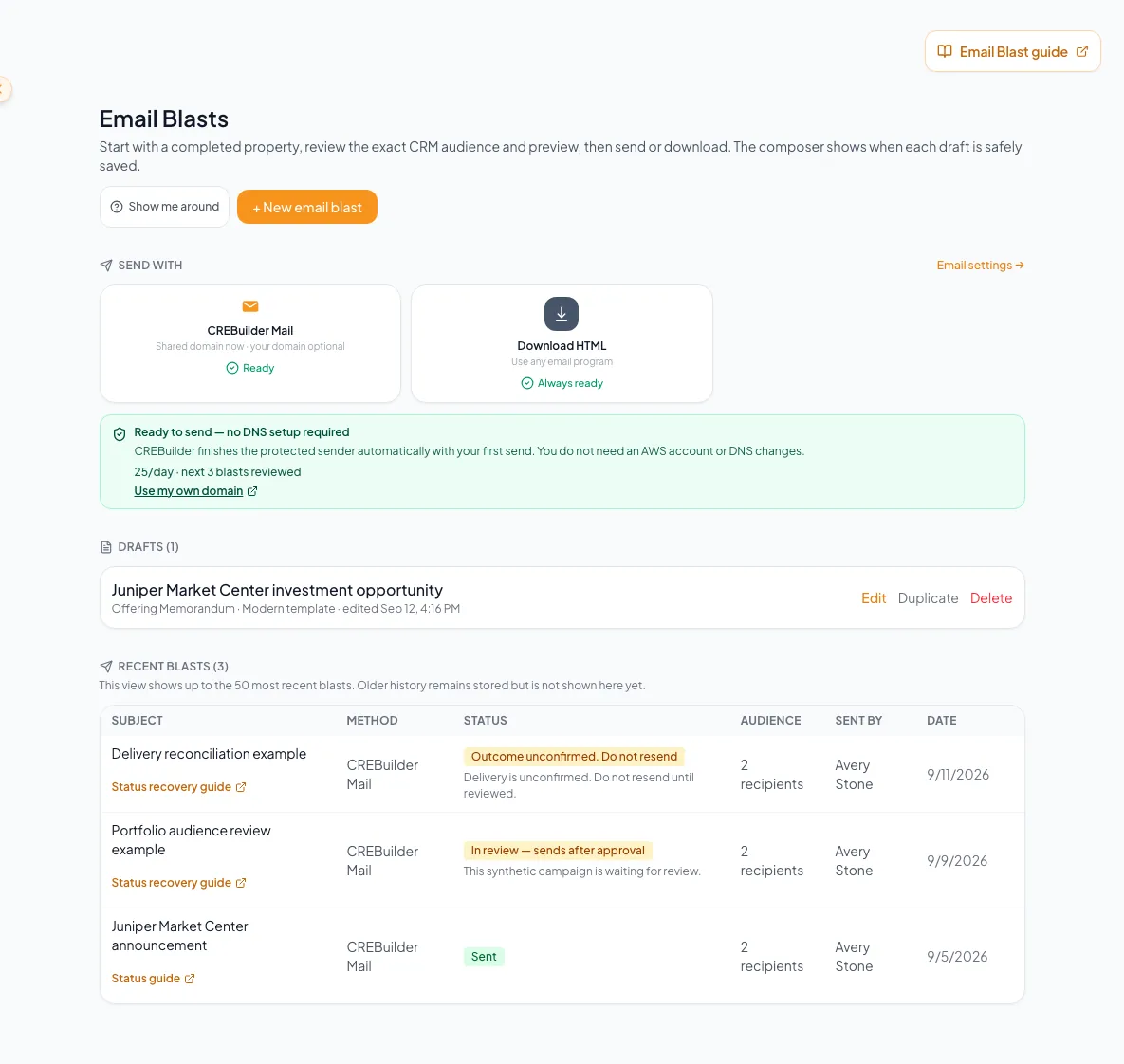
Email Blasts or Settings > Status, audience, or Recent blasts
Access
Active CREBuilder subscription for new hosted sends; prior drafts and history may remain visible
On this page
Before you start
Data, sources, and access to prepare
- The exact campaign subject, time, sender, method, and current visible status
- The original audience source and consent basis
Diagnose from local gates to transport certainty

Find the first failing layer
Start with the current durable state and move through setup, content, audience, capacity, review, and transport. Do not jump directly to resending.
Current history or setup status
Access, agreement, address, sender
Subject, HTML, links, signature
Validity, consent, suppression, cap
Daily, monthly, ramp, platform
Human review outcome
Terminal or unconfirmed transport
- Current history or setup statusAccess, agreement, address, sender
- Access, agreement, address, senderSubject, HTML, links, signature
- Subject, HTML, links, signatureValidity, consent, suppression, cap
- Validity, consent, suppression, capDaily, monthly, ramp, platform
- Daily, monthly, ramp, platformHuman review outcome
- Human review outcomeTerminal or unconfirmed transport
- 1
Capture the current durable state
Email Blasts > Recent blasts or Settings > Email sending
Record subject, time, sender, method, status, reason, and any operation identifier shown.
Expected result: You have evidence before changing the draft or audience.
If this does not happen: If the status page failed, retry it. Do not infer No request, Failed, or Not sent from a network error.
- 2
Find the first failing gate
Setup, composer, or history detail
Check setup, content, audience, allowance, review, and transport in that order.
Expected result: One actionable blocking layer is identified.
If this does not happen: Do not make unrelated changes. They can make held-operation recovery diverge from the submitted content.
- 3
Apply only the safe recovery
The identified gate
Use the matching resolution below.
Expected result: The blocker clears or support receives precise evidence after processing finishes.
If this does not happen: If status is Sending or Outcome unconfirmed, stop before any new submission.
Respect unsubscribe, bounce, and complaint suppression
| Protection | Why it exists | Recovery rule |
|---|---|---|
| Unsubscribe | The recipient asked not to receive company or applicable hosted outreach. | Do not re-add or re-import. Use an authorized correction process only for proven error. |
| Hard bounce | The address produced a durable delivery failure and harms sender reputation if retried. | Correct the underlying address with independent evidence before any authorized suppression review. |
| Complaint | The recipient or mailbox provider reported unwanted mail. | Treat as protected and do not send through another source or alias. |
| Provider opt-out from CRM import | The source system reported a do-not-email state. | The company suppression remains even after safe import undo. |
- 1
Identify the protection type
Audience result, contact context, or support detail
Determine whether the address is unsubscribed, hard-bounced, complained, or imported as opted out.
Expected result: The reason is understood without exposing internal-only data.
If this does not happen: Do not assume every removed recipient is merely invalid.
- 2
Remove it from the planned audience
Composer > Recipients
Accept authoritative filtering and do not add the same person through another list or spelling.
Expected result: The campaign contains only allowed addresses.
If this does not happen: If all recipients are removed, stop. Rebuild from a genuinely permitted audience rather than replacing identities.
- 3
Escalate only a provable error
Documented support path
Provide evidence of a corrected address or incorrect suppression without asking to bypass consent.
Expected result: Support can review the exact protected record.
If this does not happen: Until corrected through the authorized path, treat the suppression as final.
Resolve setup, review, and capacity blocks
Access or agreement blocks sending
Likely cause: Access is not approved, was denied/revoked, or a newer agreement version is not accepted.
- Open Settings > Email sending.
- Follow the current state.
- Have an authorized signer accept updated terms.
- Keep contact-email automations paused until ready.
The business address is incomplete
Likely cause: Street, city, state, or ZIP/postal code is missing.
- Update the company profile.
- Save every required component.
- Reload readiness.
- Do not insert an address manually into one campaign as a substitute.
Daily, monthly, or ramp capacity is insufficient
Likely cause: The effective audience exceeds current displayed capacity.
- Use the displayed remaining values.
- Remove nonessential recipients when the message can remain coherent.
- Wait for the proper reset or ramp increase.
- Do not split sends merely to evade a limit.
Platform Mail is temporarily paused or the tenant is suspended
Likely cause: A platform-wide capacity or tenant reputation control blocks transport.
- Keep the draft unchanged.
- Follow the displayed support or wait guidance.
- Do not repeatedly retry or move the same audience to an unapproved path.
The campaign is In review
Likely cause: Clean-send runway, Uploaded provenance, or account policy requires human review.
- Wait for approval or rejection.
- Do not duplicate the campaign.
- Expect notification when the review releases or rejects it.
The campaign was Rejected
Likely cause: Human review found a content, consent, provenance, or policy issue.
- Read the reason.
- Correct the underlying issue.
- Submit a new campaign only after the prior one is terminal and the correction is complete.
Handle failed, partial, and uncertain transport
| State | Could transport already have happened? | Action |
|---|---|---|
| Local preflight refusal | No | Correct the named gate and use a new operation only when the UI allows it. |
| Rejected review | No | Correct the review issue before a new submission. |
| Failed | Use the durable reason and certainty reported. | Do not guess. Retry only when the state explicitly establishes a safe new attempt. |
| Sent with a lower recorded sent count | Yes, for at least some recipients | Never resend the full audience. The current reviewed-send row does not expose a safe failed-recipient list, so preserve evidence and contact support. |
| Sending | Possibly | Wait. Do not resend. |
| Outcome unconfirmed | Possibly | Do not resend. Preserve operation evidence for reconciliation or support. |
- 1
Stop automatic retry behavior
Composer and browser
Do not refresh-submit, duplicate, or rebuild the audience while status is Sending or Outcome unconfirmed.
Expected result: No additional transport operation is created.
If this does not happen: If another teammate might send, notify them of the exact subject, time, and status.
- 2
Refresh the durable row
Email Blasts > Recent blasts
Refresh history after a reasonable interval.
Expected result: The same operation displays its latest durable status.
If this does not happen: Remember the hub shows only the latest 50. Capture the row while investigating.
- 3
Read the updated outcome
Email Blasts > Recent blasts > campaign row
Review the updated status and reason.
Expected result: The operation either remains pending or has reached a terminal state.
If this does not happen: Do not resubmit when the outcome remains uncertain.
- 4
Escalate with evidence
Documented support channel
Provide company, sender, subject, timestamp, status, recipient count, method, screenshots, and operation identifier if shown.
Expected result: Support can investigate one exact operation without asking you to recreate it.
If this does not happen: Do not include recipient content or personal data beyond what support requests through the approved channel.
- 5
Escalate a possible partial result
Recent blasts > Sent row
Send support the recorded sent count, effective preflight audience, and displayed broker-safe reason.
Expected result: You have a documented discrepancy without assuming which recipients failed.
If this does not happen: The row does not expose a safe failed-recipient list. A manual reconciliation can include previously unresolved rows in the recorded count. Preserve the row and contact support instead of guessing or resending.
Keep support and reporting claims accurate
Troubleshooting evidence
- Current setup or history status was loaded successfully.
- The exact subject, sender, time, method, and reason were captured.
- Audience source and consent basis are known.
- Suppressed addresses were not reintroduced.
- Displayed allowance and ramp values were recorded.
- Held, Sending, and Outcome unconfirmed states were not duplicated.
- Sent was not described as inbox delivery.
- No opens, clicks, or scheduled-send claims were made.
A stakeholder asks for open or click performance
Likely cause: CREBuilder does not currently expose those campaign analytics.
- Report only durable send status and accepted-attempt context.
- Do not reinterpret property metrics as email engagement.
- Use an approved external platform after Download HTML if that measurement is required.
A stakeholder expects a future send time
Likely cause: Hosted Mail has no in-app scheduling state.
- Confirm whether it was sent now, held, or only downloaded.
- If externally scheduled, use that external platform as the source of truth.
- Do not create a fictional CREBuilder schedule.