Outcome
The final audience contains no invalid or duplicate addresses, stays within 500 recipients, preserves source classification, and excludes every protected suppression.
Navigation path
Email Blasts > Composer > Recipients
Access
Active CREBuilder subscription for new hosted sends; prior drafts and history may remain visible
On this page
Before you start
Data, sources, and access to prepare
- A hosted Mail campaign draft
- First-party relationship and appropriate permission for every audience source
- No purchased, rented, scraped, or uncertain lists
Choose from four audience inputs
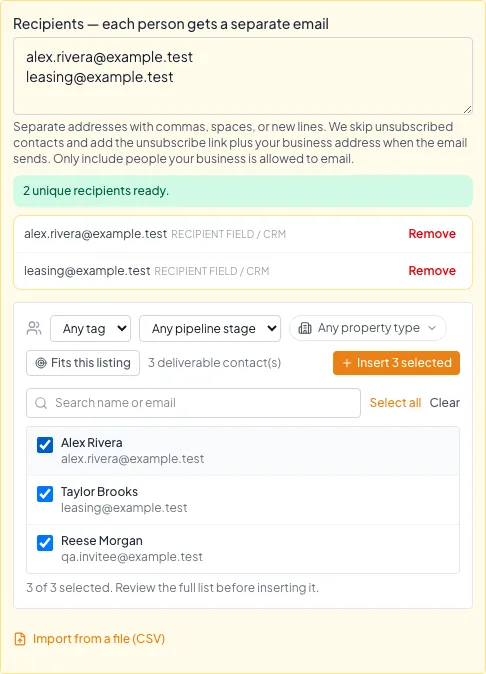
Short animated UI capture. No audio.
| Input | How it works | Important boundary |
|---|---|---|
| Typed addresses | Paste or type addresses separated by comma, semicolon, spaces, or line breaks | Strict validation and case-insensitive deduplication apply. |
| CRM picker | Filter permitted contacts by tag, any Deal pipeline stage, interested property type, or Fits this listing | Review the full returned list, search it, select the intended contacts, and confirm Insert N selected. |
| Matched audience handoff | Uses active requirements to find relevant people for one property | Fit is available only for a single-property campaign and is not consent. |
| Imported file | Scans arbitrary CSV, TXT, or TSV text under 5 MB for email-shaped tokens | No header or column mapping is required. The file is not saved with the draft. |
The CRM importer and audience importer are different
CRM contact CSV import requires headers and mapping. Email Blast recipient files are scanned as arbitrary text and do not require a header.
Add and inspect each source
- 1
Enter typed addresses
Composer > Recipients text area
Enter addresses with supported separators.
Expected result: Valid addresses normalize into the unique audience.
If this does not happen: Correct a token immediately if the composer cannot parse it.
- 2
Review typed-address feedback
Composer > Recipients feedback
Inspect the feedback for invalid or duplicate entries.
Expected result: Every invalid token is named and duplicates are excluded from the unique count.
If this does not happen: Fix or remove every invalid token. Do not proceed while client or server validation reports one.
- 3
Build a CRM selection
Composer > Add from CRM
Filter by tag, any Deal pipeline stage, interested property types, or Fits this listing for a single property.
Expected result: The picker shows the full returned, suppression-aware audience with search, individual checkboxes, Select all, Clear, and a selected count.
If this does not happen: If empty or failed, clear filters one at a time, confirm role scope, retry the request, and verify active requirements.
- 4
Search the returned CRM audience
Recipient picker > Search this recipient audience
Search for a contact in the returned list.
Expected result: Matching rows are easier to inspect; the selected count still represents the full selection.
If this does not happen: Clear the search to review contacts outside the visible matches. Searching does not change the selection.
- 5
Select the intended CRM contacts
Recipient picker > contact checkboxes
Select or clear individual contacts, using Clear or Select all when appropriate.
Expected result: The selected count reflects exactly the contacts you intend to insert.
If this does not happen: Review the full list before insertion. A property match does not establish permission to email.
- 6
Review the CRM selection
Recipient picker > selection summary
Compare the selected count with the intended audience.
Expected result: Insert N selected agrees with the reviewed contacts.
If this does not happen: Adjust the selection if the count is unexpected.
- 7
Insert the CRM selection
Recipient picker > Insert N selected
Select Insert N selected explicitly.
Expected result: The selected addresses join the composer audience without sending.
If this does not happen: Closing the picker does not insert anything. Reopen it and select Insert intentionally.
- 8
Choose an address file
Composer > Import from a file
Select a CSV, TXT, or TSV file under 5 MB.
Expected result: The composer reads addresses from the chosen file.
If this does not happen: If the file is 5 MB or larger, export a smaller first-party list.
- 9
Review the imported file
Composer > imported file chip
Inspect the file summary, including its name and extracted or duplicate totals.
Expected result: The chip shows retained unique addresses and any duplicate tokens removed.
If this does not happen: If no addresses are found, inspect the source text before choosing another file.
- 10
Re-import after a reload
Composer > Import from a file
Select the original file again after returning to a saved draft.
Expected result: The file audience is restored for the current session with provenance intact.
If this does not happen: The file is intentionally not stored with the draft. Never assume its prior recipients remain attached.
- 11
Verify the restored file audience
Composer > imported file chip
Inspect the retained unique-address count.
Expected result: The restored count agrees with the reviewed source file.
If this does not happen: Remove the imported file and choose the source again if the count differs.
Understand provenance, review, and consent
Audience classification is conservative
The server reclassifies the effective audience. One uploaded or untrusted source makes the whole list Uploaded for review and allowance policy.
Typed, CRM, match, or file inputs
All contacts have trusted captured CRM sources
Any file, manual/import/unknown, non-CRM, or mixed source
CRM audience classification
Uploaded classification
Always reviewed and half allowance
- Typed, CRM, match, or file inputsAll contacts have trusted captured CRM sourcesall trusted
- Typed, CRM, match, or file inputsAny file, manual/import/unknown, non-CRM, or mixed sourceany untrusted
- All contacts have trusted captured CRM sourcesCRM audience classification
- Any file, manual/import/unknown, non-CRM, or mixed sourceUploaded classification
| Question | Correct rule |
|---|---|
| Does a CRM record prove consent? | No. Confirm the first-party relationship and permission for the intended message. |
| Does a property match prove consent? | No. Matching establishes relevance only. |
| Can an imported CRM contact be a trusted campaign source automatically? | No. Manual, import, unknown, mixed, and non-CRM provenance is treated conservatively. |
| Can purchased or rented lists be used? | No. |
| What happens to an uploaded-classified audience? | It is held for human review and uses half the displayed allowance. |
Apply the final cap and suppression funnel
From raw inputs to final deliverable audience
The server remains authoritative even after client-side review.
All entered addresses
Strict valid addresses
Case-insensitive unique addresses
500 or fewer
Remove unsubscribe, hard bounce, and complaint
Reviewed final audience
- All entered addressesStrict valid addresses
- Strict valid addressesCase-insensitive unique addresses
- Case-insensitive unique addresses500 or fewer
- 500 or fewerRemove unsubscribe, hard bounce, and complaint
- Remove unsubscribe, hard bounce, and complaintReviewed final audience
- 1
Review the unique total
Composer > Recipients summary
Confirm deduplication across typed, file, CRM, and matched sources leaves no more than 500 unique addresses.
Expected result: The count is within the direct-send cap.
If this does not happen: Remove lower-priority segments rather than splitting one intended send to avoid a cap or allowance.
- 2
Review source classification
Composer > audience and Mail summary
Inspect the effective CRM or Uploaded classification plus its review and allowance effect.
Expected result: The expected review path and quota cost are understood before submission.
If this does not happen: If classification is Uploaded unexpectedly, inspect for a file, manual/import/unknown contact, non-CRM address, or mixed source.
- 3
Submit for authoritative suppression check
Final hosted preflight
Select the final hosted preflight action only after consent review.
Expected result: The server removes protected addresses and reports the remaining count or refusal.
If this does not happen: Do not re-add a suppressed address through another input. If every address is protected, the send is refused.
Resolve validation and audience failures
A file reports no email addresses
Likely cause: The arbitrary-text scan did not find email-shaped tokens.
- Open the source as text.
- Confirm complete addresses are present.
- Export CSV, TXT, or TSV under 5 MB.
- No header is required.
The audience exceeds 500
Likely cause: The deduplicated direct-send audience is above the campaign cap.
- Remove contacts who are not necessary for this message.
- Narrow CRM filters.
- Do not split solely to bypass compliance, review, ramp, or quota policy.
A contact is suppressed
Likely cause: The address unsubscribed, hard-bounced, complained, or carries protected provider opt-out evidence.
- Do not override or re-import the address.
- Correct a truly erroneous suppression only through the authorized support process.
- Use an appropriate alternative contact channel when lawful.
Every recipient was removed
Likely cause: All effective addresses are suppressed or invalid.
- Stop the send.
- Review how the audience was sourced.
- Do not replace protected addresses with aliases.
- Build a new permitted audience only from valid first-party consent.
Audience check
- Every source is first-party and permitted.
- No purchased, rented, or scraped list is present.
- No invalid token remains.
- Duplicates were reviewed.
- Unique total is 500 or fewer.
- CRM selection was explicitly inserted.
- File count and provenance were reviewed.
- Uploaded review and half allowance are understood.
- Suppressed addresses were not re-added.