Outcome
The rent roll uses the correct combination of cash-flow or pro-forma projection and unit-by-unit or unit-mix detail.
Navigation path
Document wizard > Rent Roll > Rent Roll Type
Access
A financial scope that includes Rent Roll
On this page
Before you start
Data, sources, and access to prepare
- A scope that includes Rent Roll
- The source rent roll or unit inventory
- A decision about annual projection versus stabilized comparison
Choose on two axes
Rent-roll model matrix
Projection controls time; layout controls row detail.
Source data
Identify detail level and analysis goal
Multi-Year Cash Flow
Annual growth and schedules
Pro Forma
In-place versus stabilized
Unit-by-Unit
One tenant, unit, suite, or space per row
Unit Mix
One repeated type or category per row
- Source dataMulti-Year Cash FlowProjection
- Source dataPro FormaProjection
- Source dataUnit-by-UnitDetail
- Source dataUnit MixDetail
The four visible projection and layout choices produce eight supported stored configurations. CREBuilder uses the standard keys for commercial-style records and adds the multifamily prefix for unit-based, non-hotel records such as Multifamily, Self-Storage, and Mobile Home Park.
| Stored configuration | Record family | Projection | Layout | Editor result |
|---|---|---|---|---|
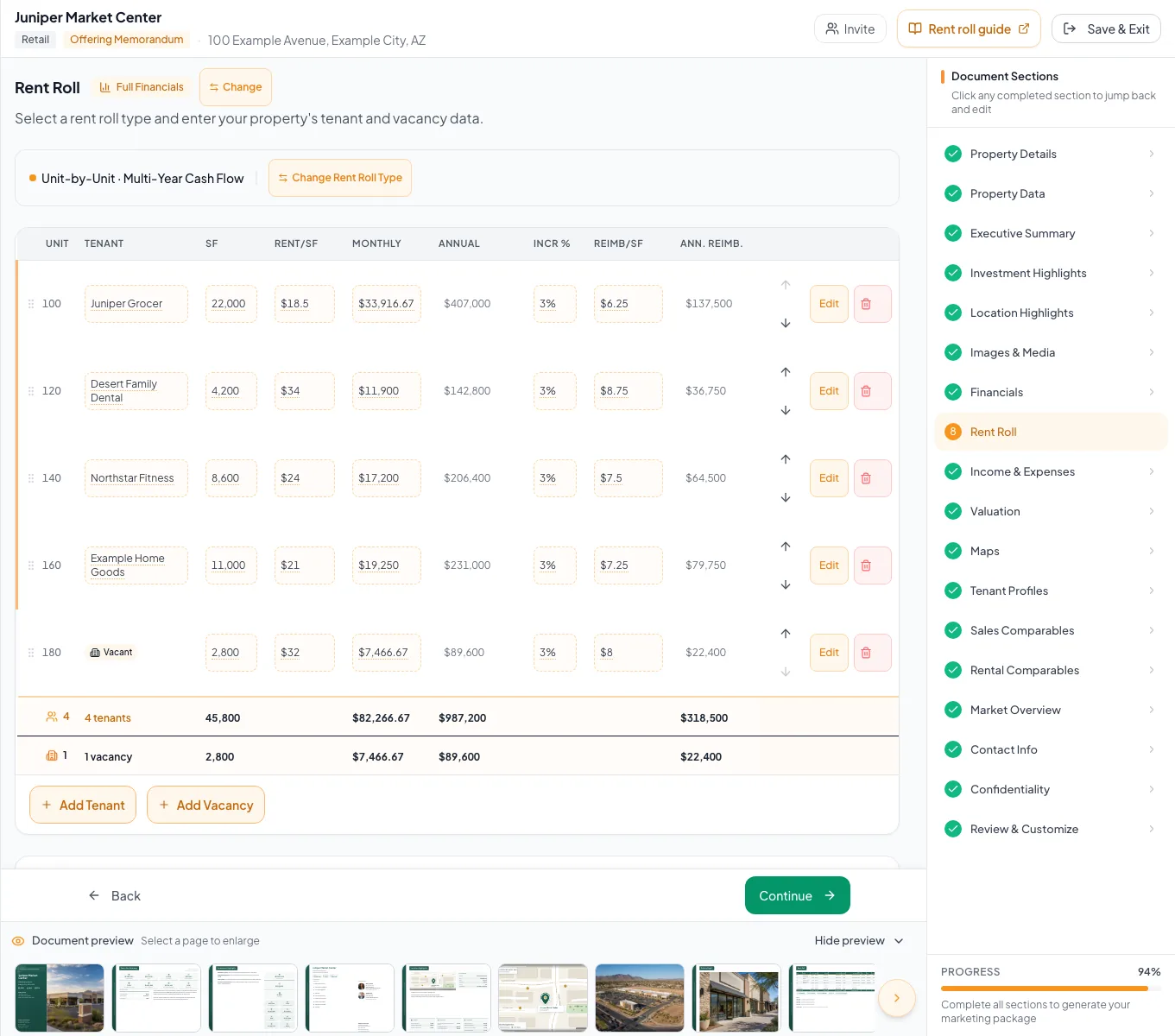
| unitbyunit-cashflow | Standard or commercial | Multi-Year Cash Flow | Unit-by-Unit | Individual tenant, suite, space, or vacancy rows with growth fields |
| unitbyunit-proforma | Standard or commercial | Pro Forma | Unit-by-Unit | Individual rows with in-place and stabilized economics |
| unitmix-cashflow | Standard or commercial | Multi-Year Cash Flow | Unit Mix | Grouped categories with counts, averages, and growth fields |
| unitmix-proforma | Standard or commercial | Pro Forma | Unit Mix | Grouped categories with in-place and stabilized averages |
| multifamily-unitbyunit-cashflow | Unit-based, non-hotel | Multi-Year Cash Flow | Unit-by-Unit | Individual unit, storage unit, or pad records with annual growth |
| multifamily-unitbyunit-proforma | Unit-based, non-hotel | Pro Forma | Unit-by-Unit | Individual unit, storage unit, or pad records with in-place and stabilized rent |
| multifamily-unitmix-cashflow | Unit-based, non-hotel | Multi-Year Cash Flow | Unit Mix | Grouped unit, storage, or pad types with annual growth |
| multifamily-unitmix-proforma | Unit-based, non-hotel | Pro Forma | Unit Mix | Grouped unit, storage, or pad types with in-place and stabilized rent |
Dedicated workflows still store a supported key
Hospitality uses Room Inventory and stores unitmix-cashflow. Single Tenant Net Lease uses Tenant & Lease and stores unitbyunit-cashflow. Mixed-Use chooses one global projection, then applies component-specific detail editors.
Expect property-specific terminology
- Commercial assets use Tenant and SF terminology.
- Multifamily uses Units and Unit Mix.
- Self-Storage uses Unit Inventory.
- Mobile Home Parks uses Pads and Pad Inventory.
- Hospitality uses a dedicated Room Inventory workflow rather than the generic four-card editor.
- Mixed-Use selects one global projection model, then configures detail within each component.
- Single Tenant Net Lease forces its dedicated single-tenant cash-flow form.
Choose before bulk entry
A different model can hide fields that do not exist in the new layout. Review the confirmation and preserve a reference copy of important source values before changing an established rent-roll type.
Select the type
Model selection steps
- 1
Open Rent Roll
Wizard navigation, Rent Roll
Open Rent Roll from the wizard navigation.
Expected result: The projection and layout choices are visible.
If this does not happen: If Rent Roll is missing, return to Financial Scope and choose Full Financials or Rent Roll Only where supported.
- 2
Choose the projection
Rent Roll Type, projection column
Select Multi-Year Cash Flow for annual growth or Pro Forma for current versus stabilized values.
Expected result: The selected projection card is highlighted.
If this does not happen: Use View Sample if the difference is unclear, then return to the selector.
- 3
Choose the layout
Rent Roll Type, layout column
Select Unit-by-Unit for individual records or Unit Mix for grouped inventory.
Expected result: The selected layout card is highlighted.
If this does not happen: Compare the source roster: if each suite or unit has distinct dates or economics, choose Unit-by-Unit.
- 4
Review the type-change warning
Change Rent Roll Type dialog
Read the complete warning after checking existing data.
Expected result: The potential effect on saved fields is understood.
If this does not happen: Cancel and record the current values if the new layout could omit needed fields.
- 5
Confirm the type change
Change Rent Roll Type dialog > Confirm
Select Confirm.
Expected result: The table reloads with the new columns.
If this does not happen: Return to the selector if the resulting columns do not match the source.
Validate the choice
Expected lease dates are missing
Likely cause: Unit Mix or the selected property type does not expose lease dates.
- Use Unit-by-Unit when individual lease records are available.
- Confirm that the property type supports lease dates.
Growth fields disappeared
Likely cause: Pro Forma compares two snapshots and does not expose the cash-flow growth columns.
- Use Multi-Year Cash Flow for annual projection.
- Use Pro Forma only when the deliverable is a two-column comparison.
Final verification
- Rent Roll Type, projection column: The selected projection card is highlighted.
- Rent Roll Type, layout column: The selected layout card is highlighted.
- Change Rent Roll Type dialog: The potential effect on saved fields is understood.
- Change Rent Roll Type dialog > Confirm: The table reloads with the new columns.
- No blocking warning, failed status, or unresolved validation message remains in the completed workflow.
Related guides
Build a commercial rent roll
Add tenants and vacancies, enter rent in the correct basis, and complete lease and reimbursement details for commercial assets.
Open guideBuild unit, storage, and pad rent rolls
Use property-specific unit inventory for Multifamily, Self-Storage, and Mobile Home Park documents.
Open guideBuild and verify a pro forma analysis
Compare in-place and stabilized rent, reimbursements, other income, expenses, and NOI without an annual projection table.
Open guide