Outcome
Saved assumptions produce an intentional annual cash-flow projection and exit value.
Navigation path
Document wizard > Valuation > Assumptions
Access
Full Financials with Multi-Year Cash Flow
On this page
Before you start
Data, sources, and access to prepare
- Full Financials
- A Multi-Year Cash Flow rent-roll type
- Approved analysis, exit, debt, and reserve assumptions
See what each assumption controls
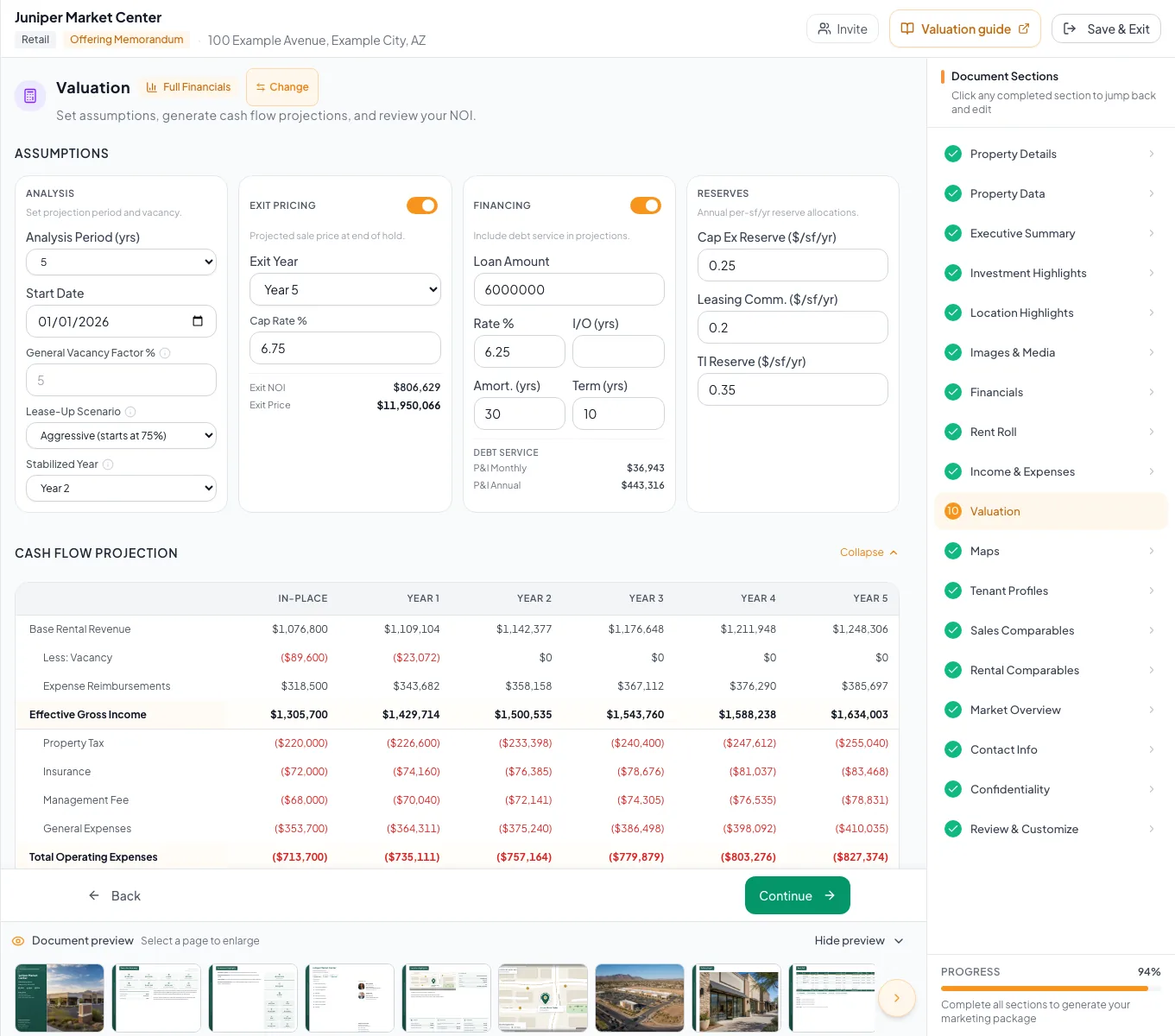
Assumptions to outputs
Each card changes a distinct part of the annual projection.
Analysis Period
Years 1 through N
Vacancy & Lease-Up
Potential income deductions
Exit Pricing
Exit-year NOI divided by exit cap
Financing
Annual debt service
Reserves
Below-NOI deductions
Cash Flow Projection
Combined annual result
- Analysis PeriodCash Flow Projection
- Vacancy & Lease-UpCash Flow Projection
- Exit PricingCash Flow Projection
- FinancingCash Flow Projection
- ReservesCash Flow Projection
| Card | Key inputs | Shown when |
|---|---|---|
| Analysis | 1 to 10 years, start date | Cash Flow |
| Vacancy & Lease-Up | Vacancy factor, lease-up preset, stabilized year | Cash Flow |
| Exit Pricing | Toggle, exit year, exit cap | Cash Flow |
| Financing | Loan amount, interest, IO, amortization, term | Cash Flow and Pro Forma |
| Reserves | Three property-specific annual rates | Cash Flow and Pro Forma |
Enter assumptions with the correct meaning
| Field | Requirement | What it means | Format | Units | Save behavior | Downstream effect |
|---|---|---|---|---|---|---|
| Analysis Period | Required | Number of projected years after In-Place. | Whole number from 1 through 10 | Projected years | Autosaves after selection; wait for the saved state before leaving. | Sets how many annual columns follow In-Place in the cash-flow preview and output. |
| Analysis Start Date | Recommended | Date context for the projection. | Calendar date | Date | Autosaves after the date change; verify the saved assumptions retain it. | Supplies the date context used to label the projection period. |
| Vacancy Factor | Optional | Economic vacancy deduction applied in projected years. | Percentage | Percent of potential income | Autosaves after entry; wait for the preview and saved state to update. | Recalculates projected vacancy deductions, EGI, and NOI. |
| Lease-Up Preset | Optional | Starting occupancy path of 100, 75, 50, 25, or 10 percent toward the stabilized year. | Select 100%, 75%, 50%, 25%, or 10% and a stabilized year | Percent occupancy and projected year | Autosaves after the preset or stabilized year changes. | Controls the projected occupancy ramp and related vacancy deductions through stabilization. |
| Exit Year and Cap Rate | Required | Selects the NOI year and divisor used for exit price. | Projected year plus positive percentage | Year number and percent | Autosaves while Exit Pricing is enabled; confirm the preview shows the intended year and rate. | Calculates exit price as the selected year NOI divided by the exit cap rate. |
| Loan Terms | Optional | Principal, rate, interest-only period, amortization, and term used for debt service. | Currency principal, annual percentage rate, and whole-year periods | Currency, percent per year, and years | Autosaves while Financing is enabled; verify the payment preview after the saved state. | Recalculates estimated payment, annual debt service, and cash after debt. |
| Reserve Rates | Optional | Three annual reserve inputs labeled for the property type. | Nonnegative currency rates | Currency per square foot, unit, room key, or pad per year, as displayed for the property | Begins an 800 ms autosave after entry; reopen assumptions to verify persistence. | Recalculates below-NOI reserve deductions using the occupied and vacant inventory quantity for the displayed reserve basis. |
Required means the field is needed to complete or support this workflow. Some screens allow a draft to save before every required item is complete. The steps and troubleshooting call out controls the product actively blocks.
Confirm reserve units in the preview
Multiply each reserve rate by its displayed basis: commercial square feet, multifamily or storage units, hotel keys, or park pads. Include occupied and vacant inventory. Compare the resulting annual deduction with the preview before publishing.
Configure and save assumptions
Assumption steps
- 1
Set the analysis period
Valuation, Assumptions, Analysis Period
Select an analysis period from 1 to 10 years.
Expected result: The preview displays In-Place plus the selected number of projected years.
If this does not happen: If the horizon is wrong, change Analysis Period and wait for autosave.
- 2
Set the analysis start date
Valuation, Assumptions, Analysis Start Date
Enter the analysis start date.
Expected result: The saved assumptions show the intended start date.
If this does not happen: Correct the date if the displayed period does not match the approved analysis.
- 3
Enter the vacancy factor
Assumptions, Vacancy & Lease-Up
Enter the approved vacancy factor.
Expected result: Projected vacancy deductions update.
If this does not happen: Confirm the input uses percent units if the deduction is implausible.
- 4
Choose the lease-up path
Assumptions, Vacancy & Lease-Up
Select the starting preset and stabilized year when lease-up is needed.
Expected result: Projected occupancy follows the selected ramp.
If this does not happen: Adjust the starting preset or stabilized year if the annual occupancy path is not intended.
- 5
Enable exit pricing
Assumptions, Exit Pricing
Turn on Exit Pricing.
Expected result: The exit year and cap-rate controls become available.
If this does not happen: Leave exit pricing off when the approved analysis has no disposition assumption.
- 6
Select the exit year
Assumptions, Exit Pricing > Exit Year
Select the approved exit year.
Expected result: The preview identifies the corresponding exit NOI.
If this does not happen: Choose a year within the analysis period.
- 7
Enter the exit cap rate
Assumptions, Exit Pricing > Exit Cap Rate
Enter the approved exit cap rate.
Expected result: The preview shows the indicated exit price.
If this does not happen: If price is blank, confirm the cap rate is nonzero and the selected year has NOI.
- 8
Enable financing
Assumptions, Financing
Turn on financing.
Expected result: The loan assumption fields become available.
If this does not happen: Leave financing off when debt is outside the approved presentation.
- 9
Enter the financing terms
Assumptions, Financing
Complete the loan amount, interest rate, interest-only years, amortization, and term fields.
Expected result: Estimated payment and annual debt service update.
If this does not happen: Check that IO years do not exceed the intended loan period and all rates use percent units.
- 10
Enter reserve rates
Assumptions, Reserves
Enter the three applicable reserve rates.
Expected result: The page begins its 800 ms autosave.
If this does not happen: Keep the page open if a value has not reached a saved state.
- 11
Verify saved reserves
Assumptions, Reserves
Reopen the assumptions after autosave completes.
Expected result: Values persist and the preview includes reserve rows.
If this does not happen: If values revert, retry each rate and verify reserve dollars against the intended basis.
Check calculated assumptions
Cash flow cannot generate
Likely cause: The backend requires a saved assumptions record.
- Change one assumption if needed.
- Wait for autosave.
- Retry the preview.
Debt service stops before the analysis ends
Likely cause: The configured loan term ended.
- Confirm the loan term in years.
- Model only the period actually financed or update the assumption.
Reserve dollars do not match a per-unit expectation
Likely cause: The saved inventory count, grouped quantity, or rate may differ from the approved source.
- Calculate the expected reserve independently.
- Do not publish until the displayed result is approved.
- Escalate the discrepancy if necessary.
Final verification
- Assumptions, Financing: The loan assumption fields become available.
- Assumptions, Financing: Estimated payment and annual debt service update.
- Assumptions, Reserves: The page begins its 800 ms autosave.
- Assumptions, Reserves: Values persist and the preview includes reserve rows.
- No blocking warning, failed status, or unresolved validation message remains in the completed workflow.
Related guides
Read and verify the cash-flow projection
Trace rent, vacancy, reimbursements, additional income, expenses, reserves, debt, and exit value through the annual projection.
Open guideModel rent escalations and reimbursements
Use annual or custom rent increases and annualize expense reimbursements without distorting projected revenue.
Open guideVerify financial pages before publishing
Confirm scope-based page inclusion, property-specific exceptions, calculations, footnotes, and final document presentation.
Open guide