Outcome
The reviewer can explain and reconcile every major line in the In-Place and projected-year cash flow.
Navigation path
Document wizard > Valuation > Cash Flow Projection
Access
Full Financials with Multi-Year Cash Flow
On this page
Before you start
Data, sources, and access to prepare
- A saved rent roll
- Saved income and expense rows
- Saved cash-flow assumptions
Follow the Multi-Year Cash Flow waterfall
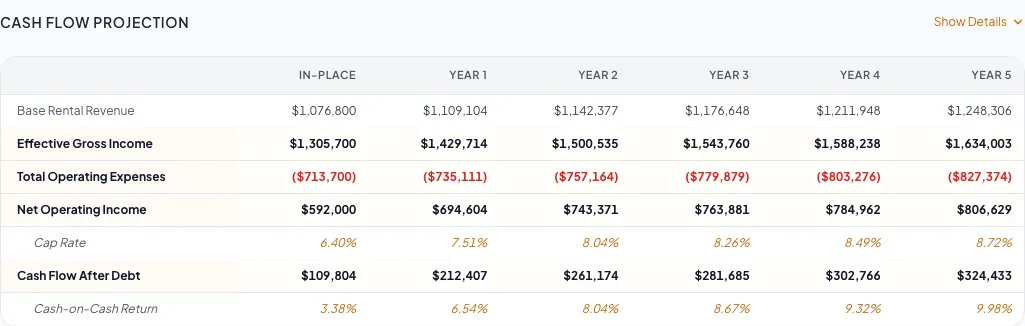
Annual cash-flow waterfall
Read each column from potential income down to cash after debt.
Gross Potential Rent
Tenant plus modeled vacancy rent
Vacancy deductions
Vacancy rows and vacancy factor
Effective Gross Income
Rent, reimbursements, and other income after vacancy
NOI
EGI less operating expenses
Below NOI
Reserves and debt service
Cash After Debt
Remaining projected cash
- Gross Potential RentVacancy deductions
- Vacancy deductionsEffective Gross Income
- Effective Gross IncomeNOI
- NOIBelow NOI
- Below NOICash After Debt
| Column or metric | Current behavior |
|---|---|
| In-Place | Current saved annual economics before projected growth |
| Year 1 | One full annual growth period after In-Place |
| Cap Rate row | NOI divided by the constant selling price shown in the preview |
| Cash-on-Cash | Cash after debt divided by selling price less loan amount |
| Exit Price | Selected exit-year NOI divided by exit cap rate |
Know the calculation order
- Tenant rent growth uses custom escalation first, row growth second, and a hidden legacy master fallback last.
- Vacancy rows use their saved growth or the legacy fallback.
- Tenant reimbursements use reimbursement growth or the legacy fallback.
- Additional-income and operating-expense rows use their own growth, with zero as the default.
- Expenses are grouped into tax, insurance, management, and all other buckets based on their names.
- Debt is interest-only for the configured IO years, amortizing afterward, and stops after the configured term.
- The standard current engine does not calculate IRR or equity multiple.
Lease dates do not prorate the projection
The annual engine does not automatically stop, start, or prorate rent from tenant lease dates. Review whole-year assumptions explicitly.
Reconcile one layer at a time
Cash-flow review steps
- 1
Start with In-Place rent
Valuation, Cash Flow Projection
Compare Gross Potential Rent and reimbursements with the saved rent-roll totals.
Expected result: The first income layer reconciles.
If this does not happen: Return to the first mismatched tenant, vacancy, count, rent basis, or reimbursement.
- 2
Reconcile vacancy and EGI
Cash Flow Projection
Compare explicit vacancy rows, vacancy factor, other income, and the resulting EGI.
Expected result: The bridge from potential income to EGI is understood.
If this does not happen: Check whether a physical vacancy row and economic vacancy factor are both intentionally used.
- 3
Reconcile expenses
Cash Flow Projection
Compare expense buckets and total expenses with Income & Expenses.
Expected result: The preview expense total agrees with the saved statement.
If this does not happen: Rename or correct expense rows if a category is grouped unexpectedly.
- 4
Recalculate NOI
Cash Flow Projection
Subtract total operating expenses from EGI.
Expected result: Displayed NOI equals the independently calculated amount.
If this does not happen: Return to the first mismatched income or expense subtotal.
- 5
Compare Year 1 growth
Cash Flow Projection, Year 1 column
Trace each change to a row growth rate, custom schedule, lease-up, vacancy factor, or expense growth.
Expected result: Every Year 1 change has an input explanation.
If this does not happen: Return to the responsible input rather than editing a calculated total.
- 6
Verify below-NOI items
Cash Flow Projection
Check reserves, debt service, and cash after debt against the assumptions.
Expected result: Below-NOI deductions are intentional.
If this does not happen: Recheck financing term, IO period, amortization, and reserve dollars.
- 7
Verify exit
Assumptions and preview
Confirm selected exit year, its NOI, and exit cap calculation.
Expected result: Exit price matches the independent calculation.
If this does not happen: Correct the year or cap rate and wait for autosave if it does not match.
Explain unexpected values
Vacancy seems counted twice
Likely cause: The model can include explicit vacant-space rent and a separate economic vacancy factor.
- Reconcile physical vacancy rows.
- Review the vacancy factor assumption.
- Use both only when the underwriting intentionally requires both.
A Mixed-Use component row differs from its source total
Likely cause: The preview allocates component gross potential rent using current in-place shares.
- Reconcile the combined total first.
- Then review the component allocation as a presentation breakdown.
IRR or equity multiple is absent
Likely cause: The standard current cash-flow response does not calculate those metrics.
- Do not infer them from exit price.
- Use only metrics displayed and verified by the current model.
Projection approved
- In-Place income reconciles
- Year 1 growth is explained
- EGI and NOI math ties
- Reserves and debt are verified
- Exit price is independently confirmed
- No unsupported return metric is claimed
Related guides
Set cash-flow assumptions
Configure the analysis period, vacancy and lease-up, exit pricing, financing, and property-specific reserves.
Open guideModel rent escalations and reimbursements
Use annual or custom rent increases and annualize expense reimbursements without distorting projected revenue.
Open guideVerify financial pages before publishing
Confirm scope-based page inclusion, property-specific exceptions, calculations, footnotes, and final document presentation.
Open guide