Outcome
Each financial record belongs to the correct building and the combined rent, EGI, expenses, and NOI reconcile.
Navigation path
Document wizard > Buildings & Properties > Rent Roll > Income & Expenses > Valuation
Access
A multi-property Offering Memorandum with Full Financials or Rent Roll included
On this page
Before you start
Data, sources, and access to prepare
- A multi-property Offering Memorandum
- Completed building records
- Rent roll and operating statement separated by building
Use one model with building ownership
Portfolio financial ownership
The model choice is document-wide, while most rows belong to a building.
One Rent Roll Type
Shared Cash Flow or Pro Forma and detail model
Building A
Tenants, vacancies, income, expenses
Building B
Tenants, vacancies, income, expenses
Portfolio-Wide Pool
Unlinked legacy income and expenses
Portfolio Financial Summary
Per-building values and combined total
- One Rent Roll TypeBuilding A
- One Rent Roll TypeBuilding B
- Building APortfolio Financial Summary
- Building BPortfolio Financial Summary
- Portfolio-Wide PoolPortfolio Financial SummaryProrated
| Area | Current behavior |
|---|---|
| Rent-roll model | One document-level type shared by all buildings |
| Field labels | Adapt to each building property type |
| Rent Roll totals | Per-building summary plus Portfolio Total |
| Expense category creation | Adding a category for one building seeds zero-value rows for other buildings |
| Legacy unlinked rows | Shown in Portfolio-wide, not assigned to a building |
| Output allocation | Unlinked rent, income, and expenses are prorated by linked gross-rent share, or equally when no linked rent exists |
Understand the combined summary
- Gross Potential Rent includes linked tenant and vacancy rent for each building.
- Explicit vacancy and the document-level vacancy factor both affect Portfolio Financial Summary when configured.
- Tenant reimbursements and building additional income add to EGI.
- Building operating expenses subtract from EGI to produce building NOI.
- Portfolio totals sum all building results after any unlinked pool allocation.
- Campus mode consolidates the summary to one Total column, while a portfolio keeps per-building columns when space permits.
- Portfolios with more than six buildings use a transposed layout.
No general Building Selector for legacy financial rows
The current Portfolio-wide income and expense area exposes unlinked rows but does not provide a reassignment selector. Resolve ownership before entry whenever possible and document any unavoidable allocation.
Enter and reconcile by building
Portfolio financial steps
- 1
Complete Buildings first
Buildings & Properties
Verify every building name, type, address, and order.
Expected result: The financial accordions have reliable owners and labels.
If this does not happen: Return here before financial entry if a record is missing.
- 2
Choose the shared rent-roll model
Rent Roll, model selector
Select the one Cash Flow or Pro Forma and Unit-by-Unit or Unit Mix structure used by the document.
Expected result: All building accordions use the selected type with property-specific columns.
If this does not happen: The model cannot vary by building. Choose the best common representation.
- 3
Open one building rent roll
Rent Roll building accordions
Expand the intended building.
Expected result: The active accordion identifies the building that will own new rows.
If this does not happen: Compare the active accordion name before adding data.
- 4
Enter the building rent roll
Expanded Rent Roll building accordion
Add only that building’s tenants, vacancies, units, rooms, or pads.
Expected result: The building summary reconciles and Portfolio Total updates.
If this does not happen: Remove a row immediately if it was added under the wrong building.
- 5
Inspect unassigned rent rows
Rent Roll, unassigned rows warning
Review every legacy row without building ownership.
Expected result: Each unassigned row is identified as required or invalid.
If this does not happen: Compare uncertain rows with the approved source before changing them.
- 6
Remove an invalid unassigned row
Rent Roll, unassigned rows warning
Delete one row confirmed to be invalid.
Expected result: The invalid orphan row no longer affects the portfolio.
If this does not happen: The current area does not reassign rows. Re-enter required data under the correct building instead of deleting it.
- 7
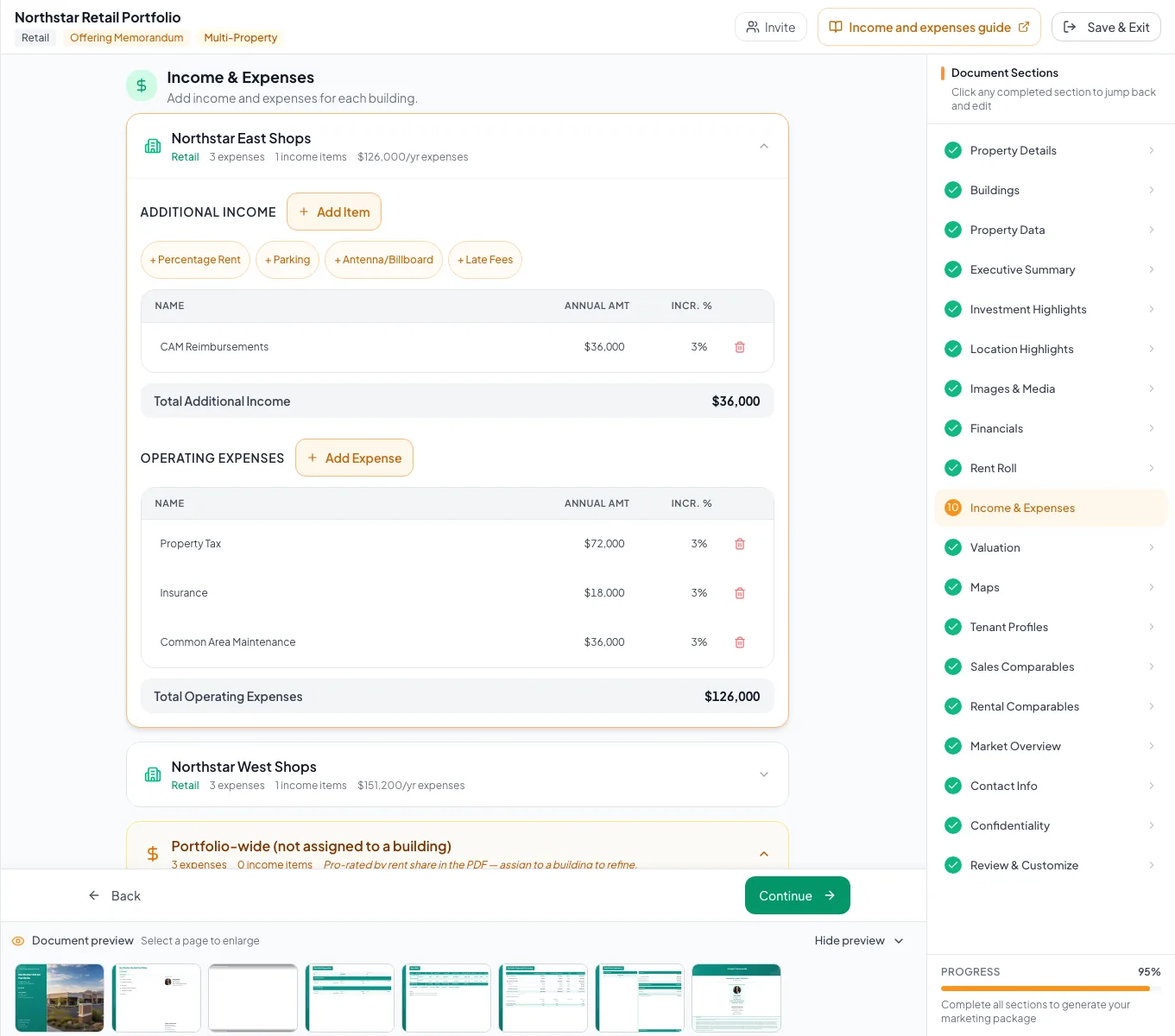
Enter building statements
Income & Expenses building accordions
Add additional income and expenses for each building in the displayed model columns.
Expected result: Building statement totals reconcile.
If this does not happen: Expect a newly added expense category to appear as zero in sibling buildings. Complete or leave intentional zero values.
- 8
Review Portfolio-wide rows
Income & Expenses, Portfolio-wide
Compare every unlinked income and expense row with the approved source.
Expected result: Any final allocation is intentional and documented.
If this does not happen: There is no current reassignment control. Re-enter under buildings and remove the unlinked row only when safe.
- 9
Verify the combined analysis
Valuation and Review & Customize
Compare building totals, Portfolio Total, vacancy, EGI, expenses, and NOI across wizard and output.
Expected result: The combined model reconciles.
If this does not happen: Trace the first difference to a building row or legacy allocation.
Resolve portfolio financial issues
Different buildings need different rent-roll types
Likely cause: The current type is document-wide.
- Choose the common model that best fits the deliverable.
- Use property-specific labels within each accordion.
- Explain exceptions in notes.
A row is unassigned
Likely cause: It may be legacy document-level data or created before the building model existed.
- Identify its correct owner from source data.
- Re-enter it under the building if necessary.
- Remove the unlinked row only after verifying totals.
A portfolio total differs from the sum expected
Likely cause: Unlinked rows, explicit vacancy, or the vacancy-factor assumption may be included.
- Check Portfolio-wide rows.
- Check vacancy records by building.
- Check the document vacancy factor.
- Recalculate EGI and NOI.
Portfolio model approved
- One shared type accepted
- Every building roster reconciled
- Every building statement reconciled
- Unassigned rows explained
- Portfolio-wide rows explained
- Portfolio Total NOI checked
Related guides
Manage building and parcel data
Enter property details and flexible property-data fields per building, copy useful rows, and understand the impact of deleting a record.
Open guideComplete a full financial analysis
Build an in-place rent roll, income and expense statement, valuation, and document-ready financial presentation.
Open guideReview multi-property document output
Verify campus, assemblage, and portfolio labels, combined rent rolls, financial summaries, pagination, maps, and orphan-data handling.
Open guide